

The complete guide
How To Choose A Silk Bonnet That Actually Stays On
The problem with waking up to a nest
You go to bed with hair that looks fine. Seven hours later it is tangled at the back, flat on one side, and frizzy everywhere else. Nothing dramatic happened. You just turned over a few times on a cotton pillowcase.
Cotton feels soft to your hand, but at a fibre level it is rough and absorbent. Every time your head moves, thousands of small hairs catch on the weave and get dragged. Over a night that adds up to a lot of friction. Over a year it adds up to breakage, frizz and a morning routine that takes longer than it should.
A silk bonnet solves this in the simplest possible way. It puts a smooth surface between your hair and everything else. Your head can move as much as it likes, and the hair moves with it inside the bonnet instead of being scrubbed against the pillow.
What 19 momme actually tells you
Momme is the silk world's weight measurement, a bit like thread count is for cotton but more honest. The number tells you how dense the fabric is. Lower numbers mean thinner silk, higher numbers mean heavier silk.
For sleepwear and bedding, the common range runs from about 16 up to 25. Sixteen momme is light and airy but gives up sooner under repeated washing. Twenty-two and above has lovely weight, though on your head it can start to feel warm.
Nineteen momme sits in the middle, and that is why so many people land on it when hunting for a best 19 momme silk bonnet. It has enough body to hold its shape over the crown rather than collapsing onto your hair, and it is still light enough that you forget you are wearing it. You get durability without bulk.
The grade 6A marking is about the raw silk thread rather than the fabric weight. It refers to filament quality, with 6A at the top of the usual scale, meaning long and even threads. In practical terms it contributes to that even, snag-free surface.
Why the tie band matters more than you think
Most bonnet complaints come down to one thing, fit. Elastic-only bonnets are a compromise. Factories pick an elastic tension that suits an average head, and if your head is smaller the bonnet works its way off during the night. If your head is larger, or you have a lot of hair pushing outward, the elastic bites and you wake up with a line across your forehead.
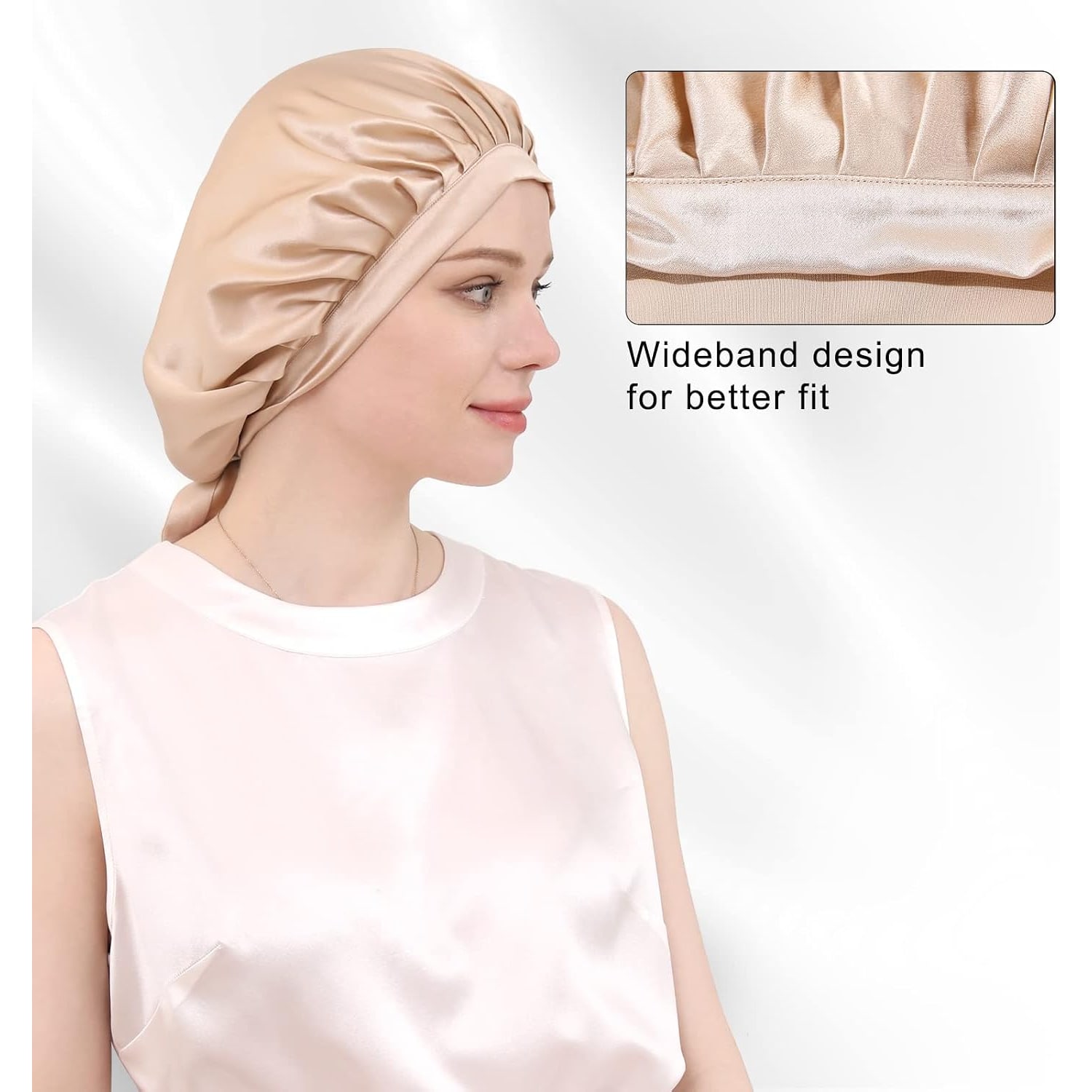
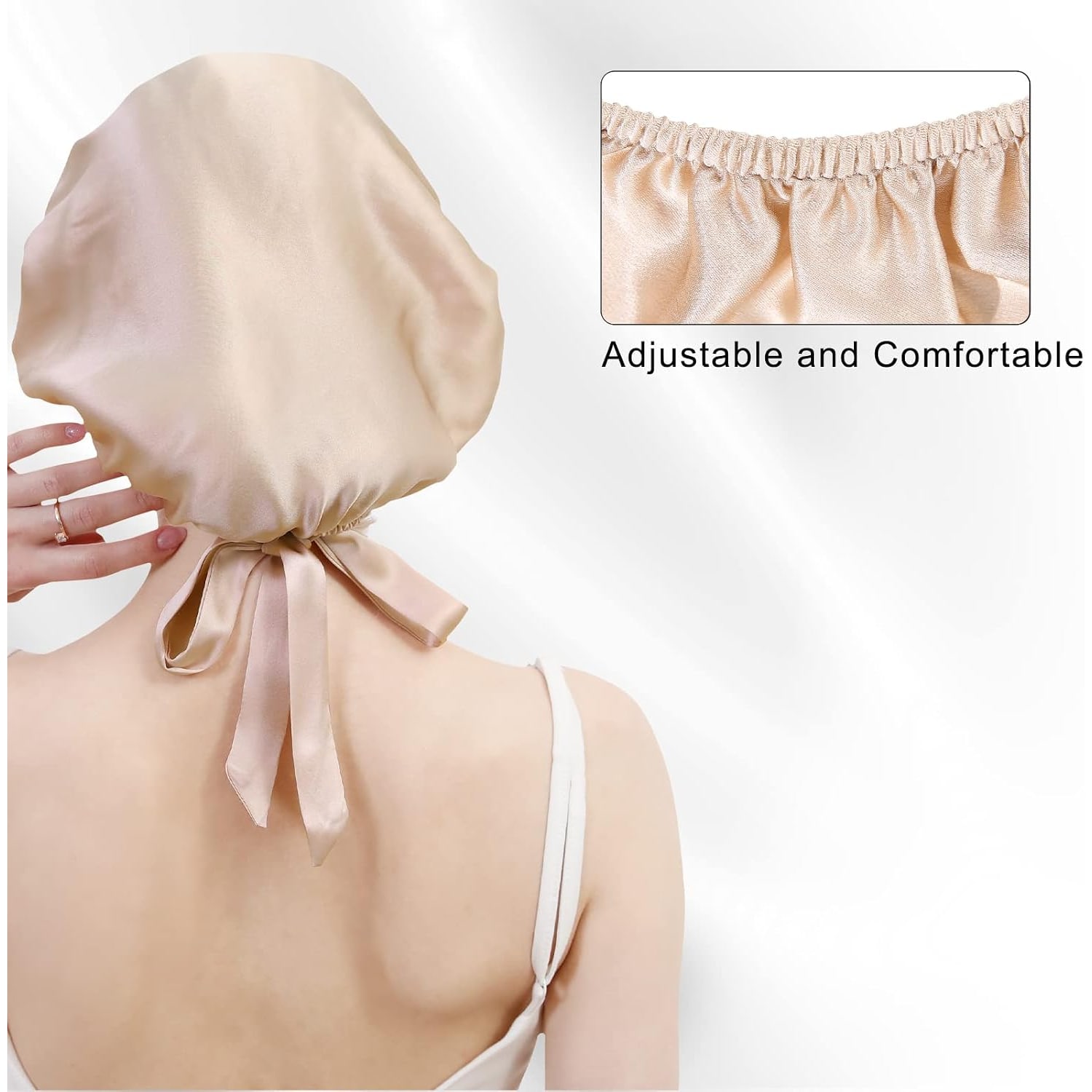
This design uses both. There is elastic around the edge doing the basic gripping, and then an adjustable tie band sitting over the top of it. You pull the tie to the tension you want and that is your fit, not the factory's guess.
It is worth spending the first few nights experimenting. Start looser than you think you need. If you wake up and the bonnet has slipped back, tighten it a little. Small adjustments, not big ones. Once you find the setting that works, it tends to stay right.
The tie also helps as your hair changes. A freshly washed and blow-dried head takes up a different amount of space than a week-old protective style. One bonnet handles both.
Who this suits
Anyone with long hair gets an obvious benefit, because long hair has more surface area to drag across a pillow and more length to tangle with itself. Coiling it loosely inside the crown keeps the whole length contained.
Curly and coily hair benefits for a different reason. Curls lose definition when they are compressed and rubbed. A roomy bonnet lets the pattern sit rather than flatten, which is why people search specifically for a best silk bonnet for curly hair rather than just any cap. Gather the curls gently on top of your head before putting the bonnet on, and they have somewhere to go.
Braids, twists and other protective styles fit the same way. Loop longer braids loosely before covering so nothing is pulling at the roots.
If your hair is short, fine or you buzz it, the case is weaker. A silk pillowcase might make more sense for you, since there is not much length to protect.
People who use oils, masks or leave-in treatments overnight also find a bonnet useful, because it keeps the product on their hair rather than on the bedding. Just expect to wash the bonnet a bit more often.
Silk versus satin, and why it is not the same thing
This trips people up constantly. Satin is a weave, not a material. You can weave satin from polyester, and most inexpensive caps sold as satin are exactly that. Polyester satin is smooth, and it does reduce friction compared to cotton, so it is not useless.
Mulberry silk is a natural protein fibre. It is smooth in the same way, but it handles differently, breathes differently and tends to feel cooler against skin. It also costs more, which is the honest trade-off.
If you are comparing options and the listing says satin without naming the fibre, it is almost certainly polyester. This one is stated plainly as 100% mulberry silk.
Looking after it
Care here is simple but not optional. Hand wash only.
Use cool water, never hot. Add a small amount of mild detergent made for delicates, swish the bonnet through gently for a minute or two, then rinse until the water runs clear. No bleach, no fabric softener, no scrubbing.
When it comes out, do not wring it. Twisting stresses the fibres and can distort the elastic. Press the water out between your palms, or roll the bonnet in a clean towel and press down. Then reshape the crown and lay it flat to dry somewhere out of direct sun and away from heaters.
It dries quickly, usually faster than people expect, because it is one thin layer.
How often? Every week or two for most people. If you use heavy oils or creams, make it weekly, because product builds up on the inside and the fabric slowly stops feeling slippery. That build-up, not wear, is usually why a bonnet starts underperforming.
Many people keep two in rotation. One on the head, one drying. It saves you from the night you forgot to wash the only one you own.
Getting more out of it
A few small habits help. Make sure your hair is dry or close to dry before you put the bonnet on, because trapping damp hair under silk overnight is not comfortable and does not help the fabric.
If you have a particular style you are trying to preserve, think about where the bonnet sits. Pulling it down low over the forehead flattens a fringe. Setting it slightly back leaves more room.
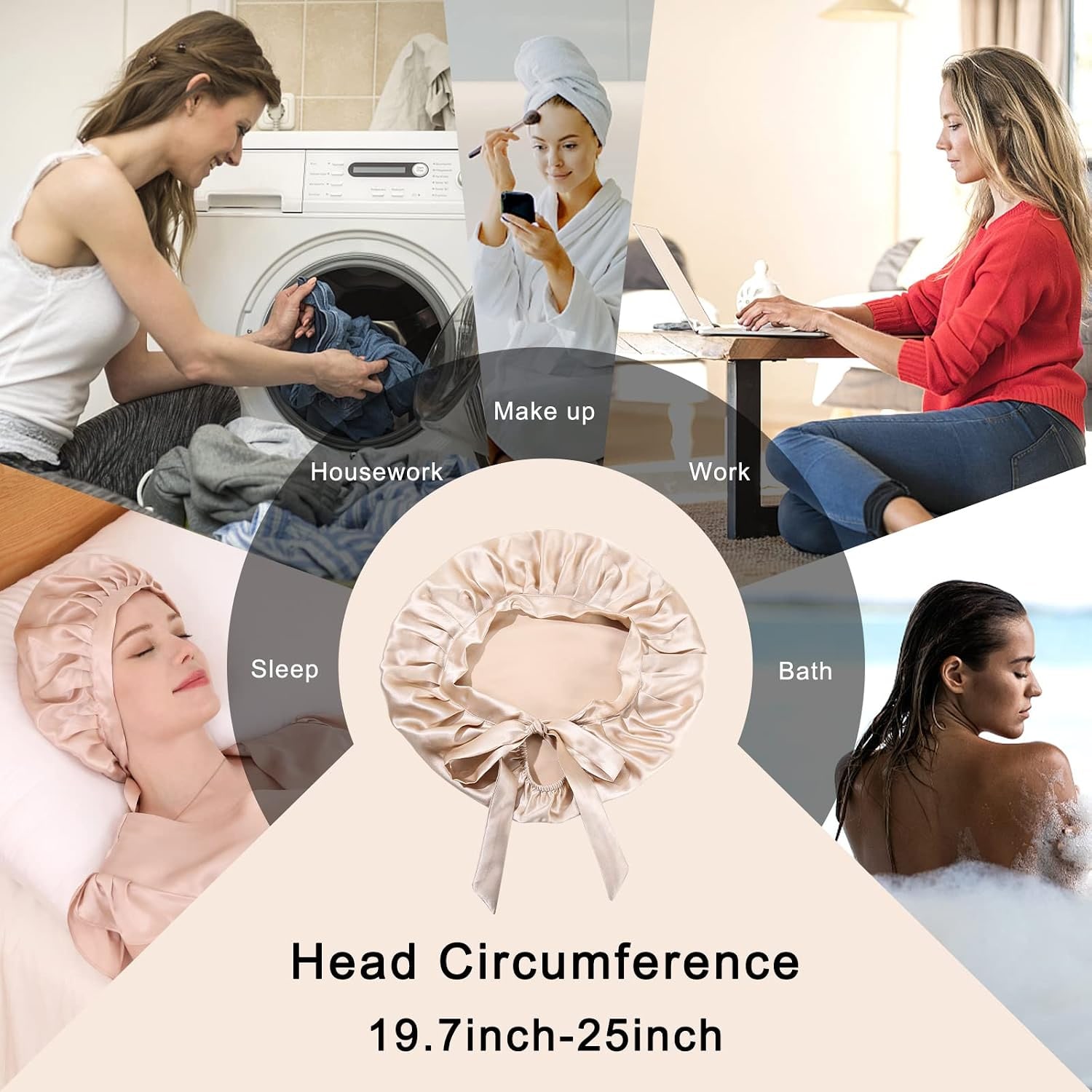
It is also worth remembering this is not strictly a bedtime item. A lot of people reach for it while washing their face or doing their makeup, simply because it holds all the hair back in one go. Keeping it on the bathroom shelf rather than buried in a drawer means you actually use it.
For travel it is almost ideal. It folds into nothing, weighs almost nothing, and means you are not at the mercy of whatever pillowcase a hotel provides.
The short version
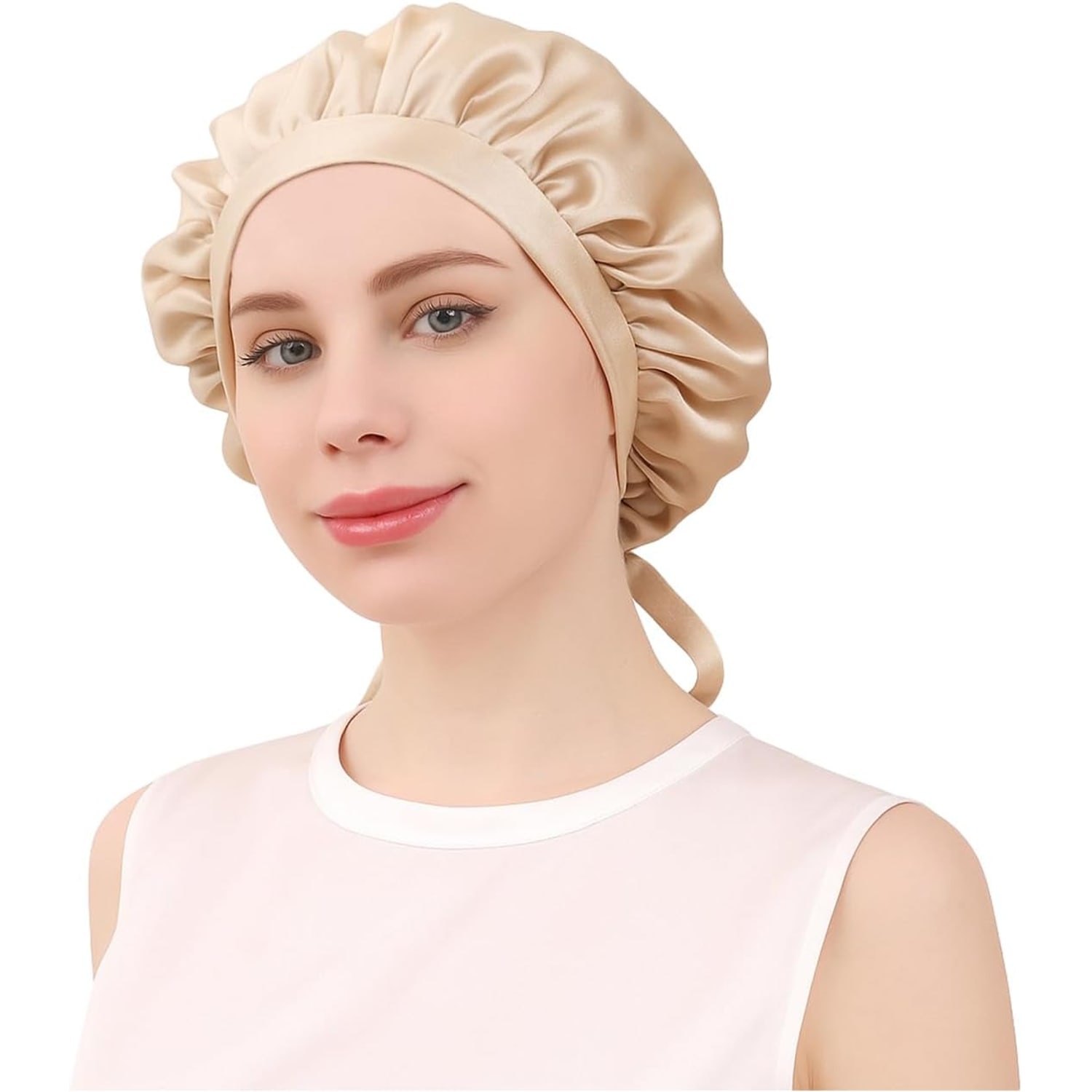
A silk bonnet is a small, cheap change that reduces the friction between your hair and your bed. This one is 100% mulberry silk at 19 momme, which is the practical middle weight, with a 6A grade filament, a solid champagne colour, and a crown cut roomy enough for long, curly or braided hair.
The thing that sets it apart from a basic cap is the fit. Elastic edge plus adjustable tie band means you set the tension, rather than hoping the factory guessed your head size correctly.
Hand wash in cool water, dry flat, keep it away from heat, and it will keep doing its job. If your hair is long, curly, textured or just prone to waking up in a tangle, it earns its place on the bedside table quickly.