
The complete guide
How to Choose a Contoured Silk Sleep Mask
The problem with most sleep masks
You buy an eye mask because the streetlight bleeds through the curtain, or your partner reads late, or you are trying to sleep on a plane at two in the afternoon. Then you put it on and discover a second problem. The fabric is resting directly on your eyelids. Every time you blink, you feel it. If you wear lash extensions, the mask flattens them. And despite all that contact, light still sneaks in along the side of your nose, which is the one place a flat band cannot seal.
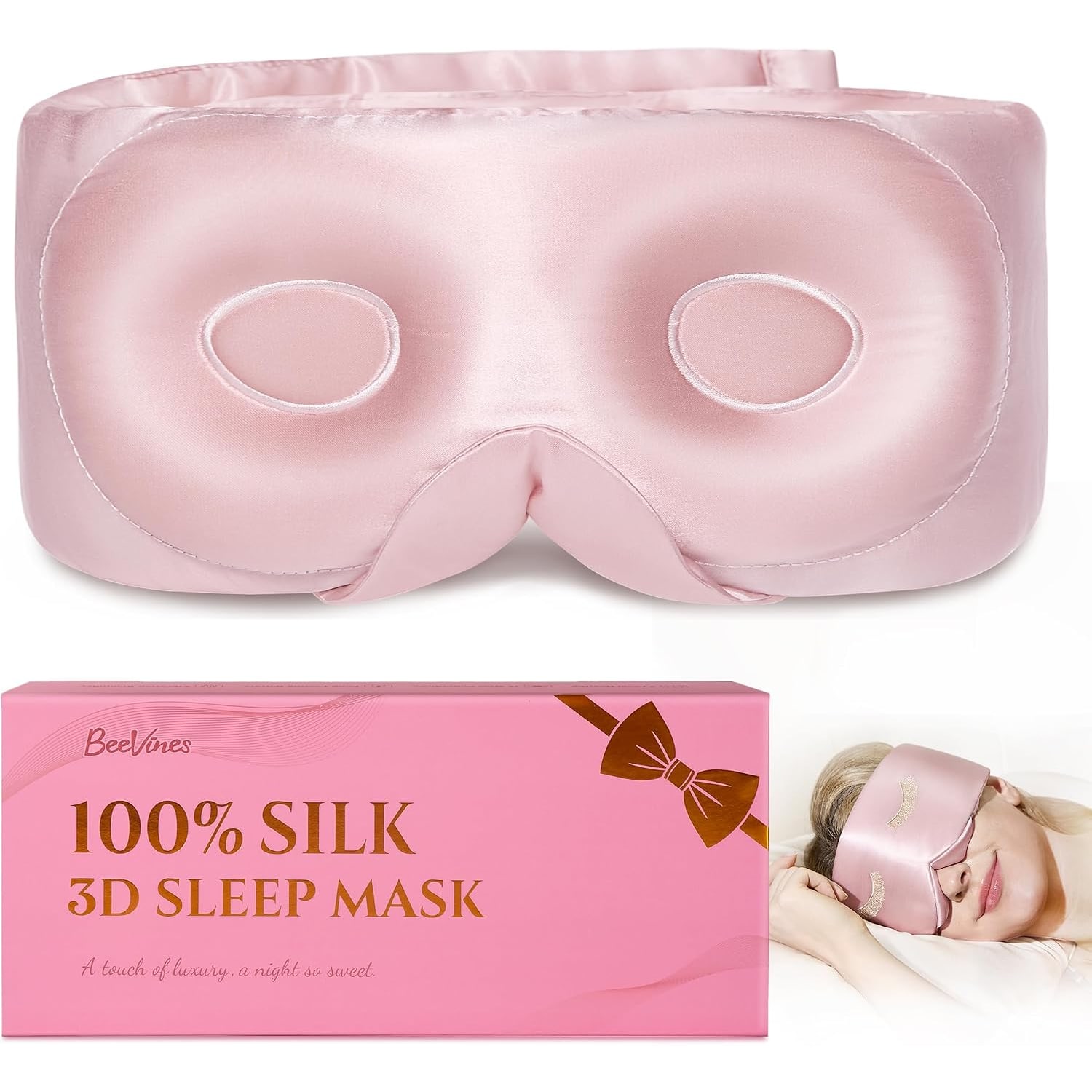
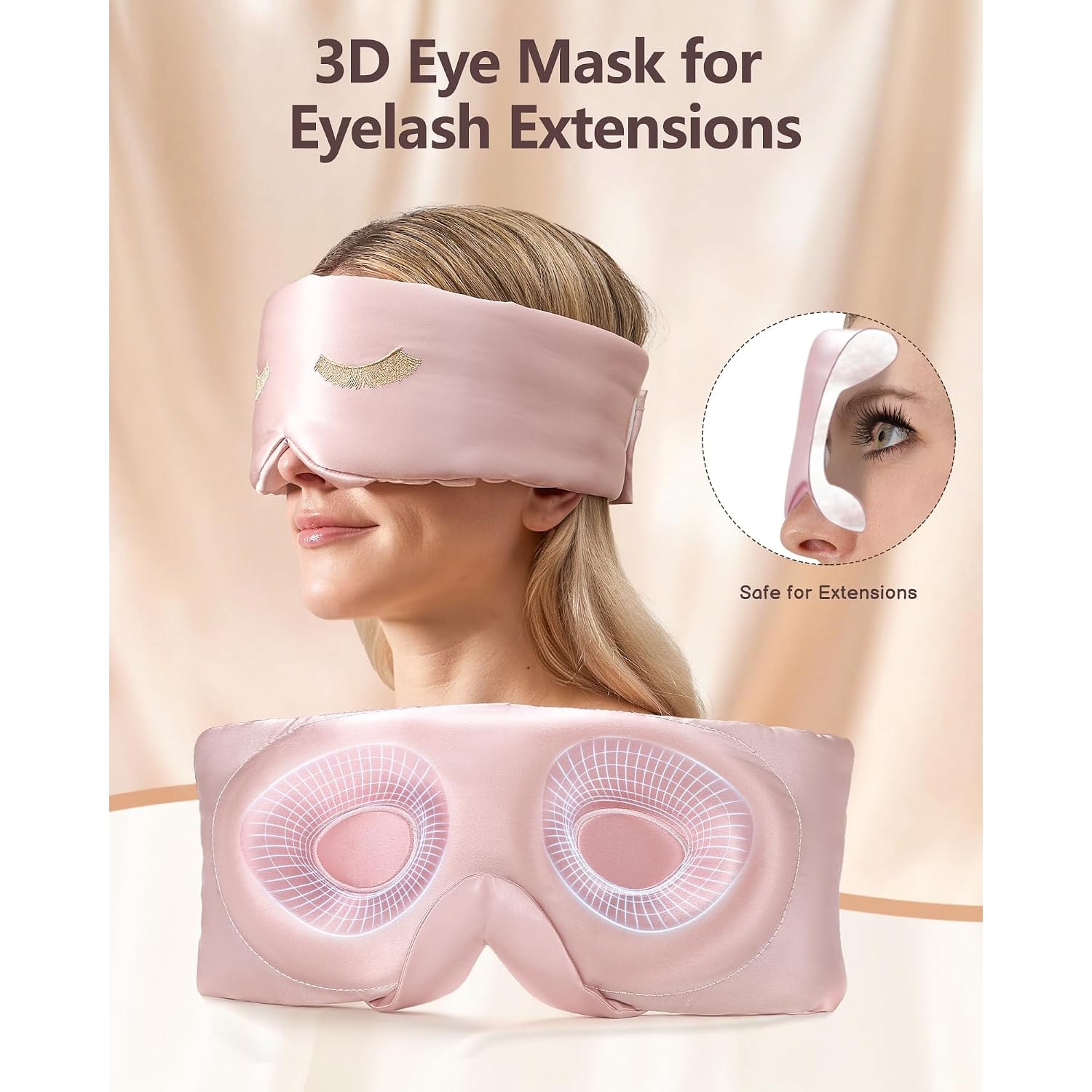
That is the gap a contoured mask fills. Instead of a single piece of fabric stretched across your face, the mask is moulded into two domes. Each dome arches over an eye socket and rests on the bone around it, not on the eye. The space inside is small, maybe a centimetre or so, but it is enough that nothing touches your lashes or lids. You can open your eyes under the mask and see nothing but black.
How the shape actually works
Think of the structure as three parts doing three jobs.
The cups create the clearance. They sit on the brow bone above and the cheekbone below, which are both firm enough to carry a little pressure comfortably. Because the fabric never presses in, you avoid that slightly swimmy feeling of pushing on your own eyeballs for eight hours.
The nose pad closes the leak. If you have ever lifted a flat mask off your face in the morning and noticed two bright wedges of light either side of your nose, you know the issue. The bridge of the nose makes a triangular gap that flat fabric bridges straight over instead of following. A shaped pad drops down into that gap. It will not be perfect for every nose shape, but it cuts the leak dramatically compared to no pad at all.
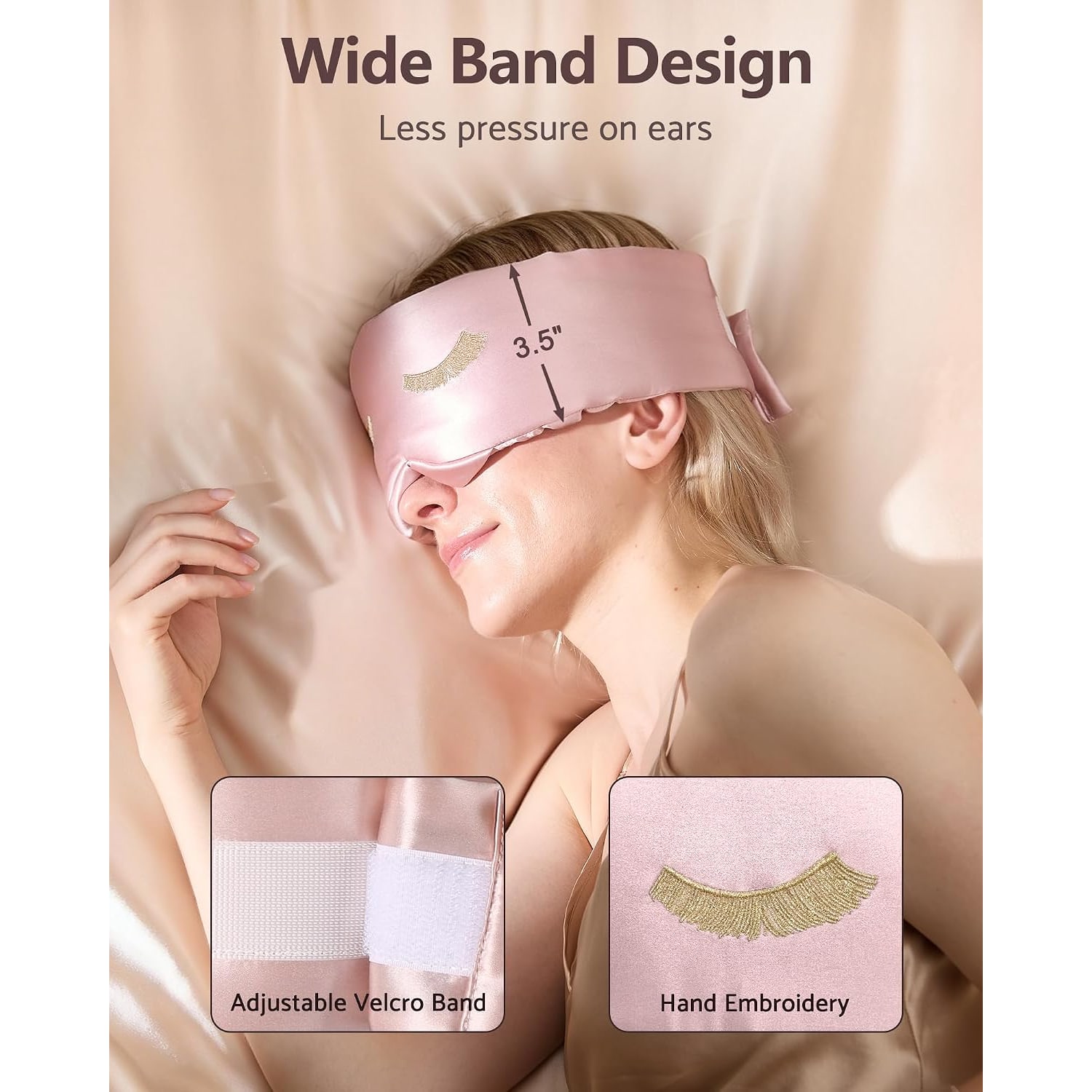
The band holds it all in position. This one is 3.5 inches (9 cm) wide and fastens with hook and loop. Width matters more than people expect. A thin elastic cord concentrates all its tension along one narrow line, which is why you wake up with a red stripe and sometimes a dull ache. A wide band spreads the same holding force across a much larger patch of skin, so you feel it less.
Why 22 momme silk matters
Momme is the unit silk is sold by, and it measures weight rather than thread count. Higher momme means more silk fibre in the same area. Common weights for silk bedding and sleepwear run from about 16 up to 25, and 22 sits comfortably in the upper half of that range.
For a sleep mask, the practical effects of a higher momme are straightforward. The fabric is denser, so less light passes through the weave itself. It has more body, so the moulded cups hold their shape better than they would in a flimsy fabric. And it simply feels more substantial. There is a noticeable difference in the hand between thin, slippery silk and a proper 22 momme piece.
The silk here is mulberry silk graded 6A. Mulberry silk comes from silkworms raised on a single diet of mulberry leaves, which gives long, uniform filaments. The 6A grade refers to the quality tier of that raw filament, with 6A being the top band in the common grading scale.
Silk against your skin
Silk has a much smoother surface than cotton at the fibre level. Cotton fibres are short and have a slightly rough, twisted structure, which is why cotton grips. Silk filaments are long and smooth, so skin and hair slide across them instead of catching. On a sleep mask, that means less tugging at the delicate skin around the eyes when you turn over, and less friction against your hairline.
It also feels cool when you first put it on, which some people like and some find a bit startling. It warms to body temperature within a minute or two.
Who this suits
Light sleepers are the obvious group. If a sliver of light under the door is enough to keep you awake, the combination of dense fabric, deep cups and a nose pad gives you a darker field than a basic mask.
Anyone with lash extensions, lash lifts or recently had eye work should be looking at contoured shapes specifically. The whole point is zero contact with the lashes.
Shift workers sleeping in daylight need more darkness than night sleepers, full stop. A good mask is one layer of that, alongside curtains.
Travellers get a lot out of it. Planes, trains and unfamiliar hotel rooms rarely go properly dark, and a mask that folds into a pocket solves the problem without packing anything bulky.
Side sleepers can use a contoured mask, though it is worth knowing that any three-dimensional shape has a little more depth against the pillow than a flat one. Loosening the band slightly usually sorts out any pressure on the temple.
How to get the fit right
Put the mask on before you lie down and adjust it sitting up. Start looser than you think you need. Press the hook and loop together, then lie down and see if light comes in. If it does, note where. Light at the nose means the pad is not seated, so slide the mask down a few millimetres. Light at the outer edge usually means the band is too loose on that side.
Fasten the hook and loop before you pull the mask over your head, not after. An open hook strip will grab loose hair every single time. This one small habit makes the difference between a mask you love and a mask you resent.
If you wear the band low on the back of the head, it tends to stay put better than high up near the crown, where it can slide as you move.
Looking after it
Hand wash only. That is not a soft suggestion with silk, it is the care instruction. Cool water, a mild detergent made for delicates, and gentle squeezing rather than rubbing or wringing. Silk fibres are strong but they do not like being twisted while wet.
Press the water out between two towels, reshape the cups with your fingers, and lay the mask flat to dry somewhere out of direct sun. Sunlight fades dyes and can weaken the fibre over time. Skip the dryer entirely.
Keep the hook and loop fastened while it is in the water. An open hook strip tumbling around in a basin will snag the silk and pull threads.
Wash it weekly or fortnightly with nightly use. If you apply eye cream or face oil before bed, give it a few minutes to absorb first, and wash the mask a little more often.
When you travel, keep it in a small pouch rather than loose in a bag. Zips and velcro on other items are the main threat to silk.
The short version
A contoured mask solves two problems at once. The moulded cups keep fabric off your eyelids and lashes, so there is no pressure and no flattening. The shaped nose pad plugs the gap where almost all light leaks in. Add 22 momme mulberry silk and a wide 3.5 inch (9 cm) adjustable band, and you get a mask that is dark, smooth and comfortable enough to actually keep on all night.
Set the band a touch looser than feels necessary, fasten the hook and loop before you put it on, and hand wash it. That is genuinely the whole maintenance routine.