
The complete guide
How to Choose a Mulberry Silk Pillowcase, A Practical Buyer's Guide
The small annoyance that sends people shopping for silk
Most people do not wake up one morning and decide they need silk bedding. What usually happens is smaller and more irritating than that. You notice your hair looks flattened and roughed up on one side every morning. You notice a crease pressed into your cheek that takes half the morning to settle. You notice that your pillowcase feels warm and a bit clammy by two in the morning in July.
None of those things are emergencies. They are just daily friction, in the literal sense. A cotton pillowcase is made from short staple fibres, and under magnification the surface looks more like a woven rope than a sheet of glass. Every time you turn over, your hair and skin drag across that texture. Silk is different at the fibre level. It is a long continuous filament, so the surface it weaves into is far smoother, and things slide across it instead of catching.
That is the whole pitch. No miracle claims required. The surface is smoother, and you can feel it the first night.
What mulberry silk actually is
Mulberry silk is silk from silkworms raised on mulberry leaves. It is the standard for bedding because the filaments come out long, pale and fairly uniform, which makes a smooth, even fabric. Wild or tussah silks are coarser and more irregular, which is lovely for a scarf and less pleasant under your face.
Within mulberry silk there is a grading system that runs up to 6A. The grade is about the length and consistency of the filaments used, not about how shiny the finished item looks. This pillowcase is listed by the maker as grade 6A, which is the top of that scale.
Then there is momme. Momme is a weight unit, and it is the single most useful number on any silk bedding listing. It tells you how dense the weave is. Common weights run from about 16 at the light end up to 25 at the heavy end. This case is 21 momme.
Why 21 momme is the sweet spot
Think of it like denim weight. Lightweight denim is comfortable but thin, and it wears through at the knees sooner. Heavyweight denim lasts for years but takes a while to break in and costs more.
Silk is similar. A 16 or 19 momme case feels light and cool, costs less and can look slightly translucent over a dark pillow. A 25 momme case feels dense and almost liquid, and it is noticeably more expensive. At 21 momme you get a fabric with real body, one that drapes over the pillow with a bit of weight and holds up through regular washing, without stepping into premium pricing territory.
If you are comparing listings and trying to find the best mulberry silk pillowcase for your money, momme is the number to line up side by side. Thread count gets quoted too, and this one lists 600, but thread count is a measure borrowed from cotton weaving and it tells you less about silk than momme does.
Silk on both sides is not a given
This is the detail that catches people out. A surprising number of pillowcases sold as silk are silk on one face only, with a cotton or polyester backing. The maker is not necessarily hiding it, but it is easy to skim past.
The practical problem is simple. You flip your pillow. You turn over in the night. The case gets pulled out of the laundry basket and put on in whatever orientation your hands happened to grab. If only one side is silk, you have a coin flip every night. A both sides silk pillowcase removes that entirely. This one is 100% mulberry silk front and back, so there is no wrong way round.
Zip versus envelope
The two common closures are the envelope flap, where a tongue of fabric folds over the open end, and a zip.
Envelope closures are cheaper to make and slightly easier to wash because there is no hardware. The catch is that pillows migrate. Over several hours of shifting around, the pillow works its way toward the open end and you wake up with a bare corner poking out. On a slippery fabric like silk, this happens faster than it does on cotton.
A zip closes the end properly. The concern people raise is snagging, and it is a fair one, which is why a hidden zip set into the seam is the better design. This case uses a hidden zipper. Keep the zipped end at the foot of the pillow, away from your face, and you will rarely think about it again.
Getting the size right
Canadian pillow sizes are fairly standardized. Standard is 20 x 26 inches (51 x 66 cm), queen is 20 x 30 inches, and king is 20 x 36 inches. This case is cut for standard.
Measure your pillow before you order. It takes thirty seconds and it is the most common reason silk pillowcases get returned. A standard case on a queen pillow will not close, and a queen case on a standard pillow will bunch and wrinkle. If your pillow has lost loft over the years it may measure smaller than the label said when you bought it, so trust the tape measure rather than the packaging.
Also note that one pillowcase comes per pack. For a double bed with two pillows, order two.
Why ivory is the easy choice
Colour decisions in bedding are more stressful than they need to be. Ivory white solves most of them. It is a warm, soft white rather than a clinical bright white, which means it sits comfortably next to cream, beige, grey, linen tones and true white alike. It does not try to be the feature of the bed.
If you are buying a best ivory silk pillowcase as a present, the neutral shade is doing real work. You do not need to know what colour anyone's duvet cover is.
Living with it, washing and all
Silk is a protein fibre, closer in nature to hair than to cotton. That shapes how you care for it. The guidance for this case is a gentle hand wash in cool water with a mild detergent made for delicates, or dry cleaning. No bleach.
In practice, a hand wash takes about five minutes. Fill a basin with cool water, add a small amount of delicate detergent, swish the case through for a minute or two, rinse until the water runs clear, then press the water out against the side of the basin. Do not wring or twist it. Lay it flat on a towel, roll the towel up to absorb the moisture, then dry flat or hang in the shade. Direct sun and hot dryers are the two things that age silk fastest.
If it needs pressing, use a low iron on the reverse side while the fabric is still slightly damp.
A useful habit: buy two cases and rotate them. Each one gets a rest between washes, and you are never stuck without a clean one. People who do this tend to report their silk lasting considerably longer.
Who this suits, and who it does not
It suits anyone with long hair who is tired of morning tangles, anyone who sleeps warm, and anyone who just likes the feel of good fabric. It works well as a travel item too, since a single case packs down to almost nothing and gives you a familiar surface in a strange hotel.
It does not suit someone who wants to throw everything in a hot machine wash with the towels. Silk asks for a little care. If that sounds like a chore rather than a two-minute routine, a good cotton sateen may make you happier.
The short version
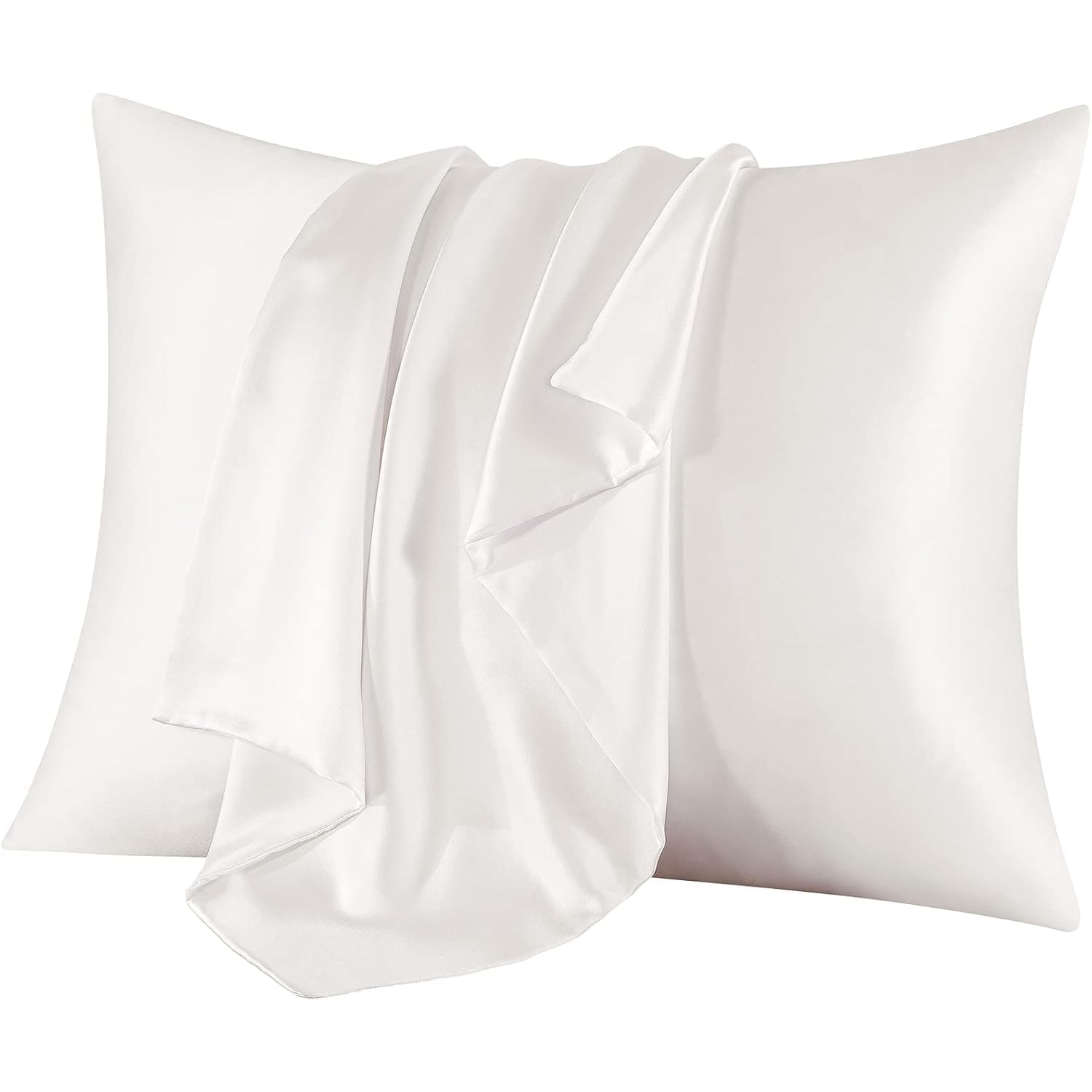
This is a 100% mulberry silk pillowcase, grade 6A, woven at 21 momme, silk on both faces, in a plain ivory white, cut for a standard 20 x 26 inch (51 x 66 cm) pillow and closed with a hidden zip. One case per pack. Hand wash gently or dry clean, no bleach, dry away from heat.
Check your pillow size, decide whether you want one or a pair, and that is the whole decision.