
The complete guide
How To Choose A Large Silk Shawl And Actually Wear It
The gap this fills
Most people have a wardrobe gap that sits between a jacket and nothing at all. You walk out in the evening and the air has cooled by a few degrees. You sit down in a restaurant under an air-conditioning vent. You get on a plane and the cabin turns cold somewhere over the second hour. A coat is too much. Bare shoulders are not enough.
A large silk shawl covers that gap better than almost anything else, because it gives you a layer that you can put on and take off in two seconds and then fold into a small square when you do not want it. It takes up almost no room in a bag. That combination, useful when you need it and invisible when you do not, is the whole argument for owning one.
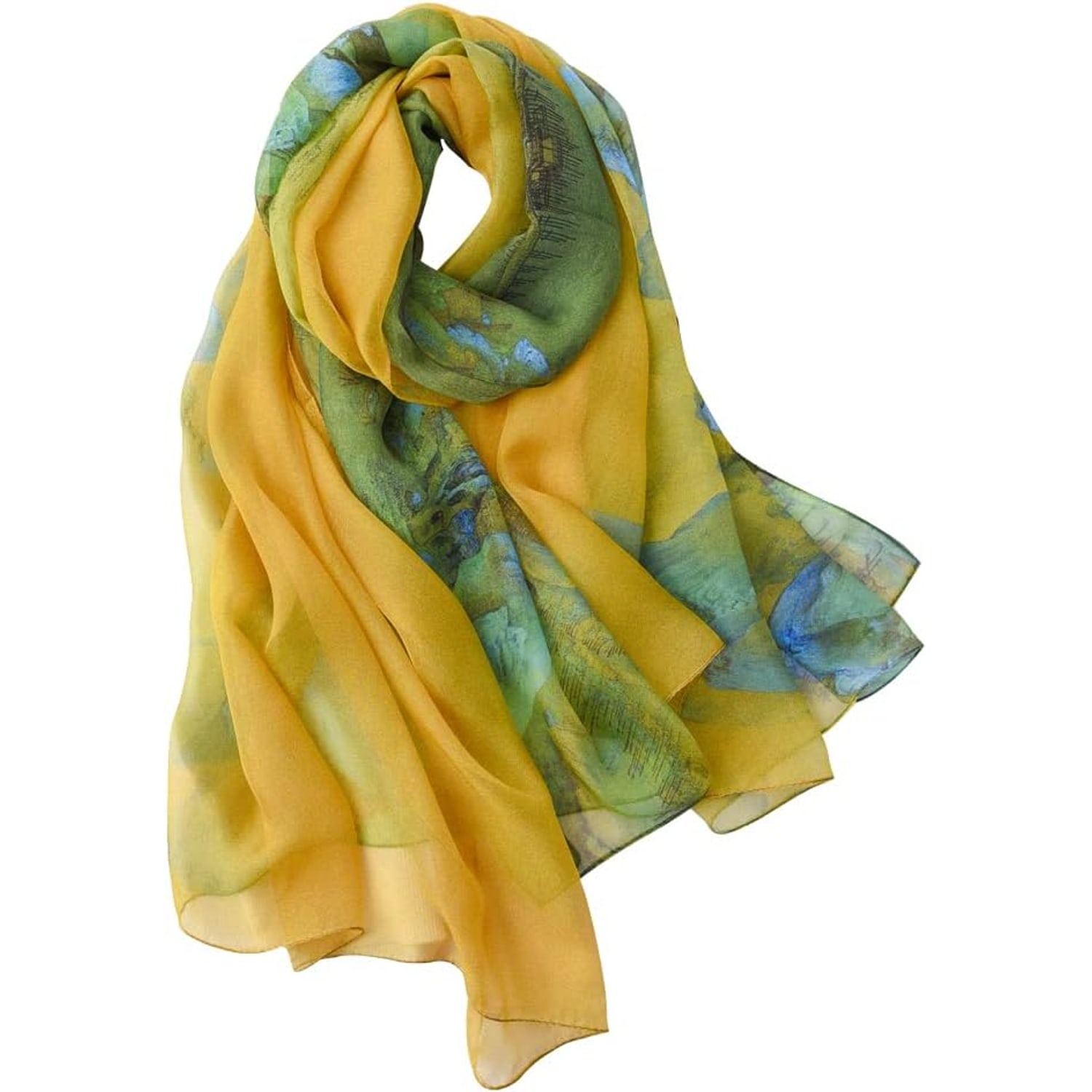
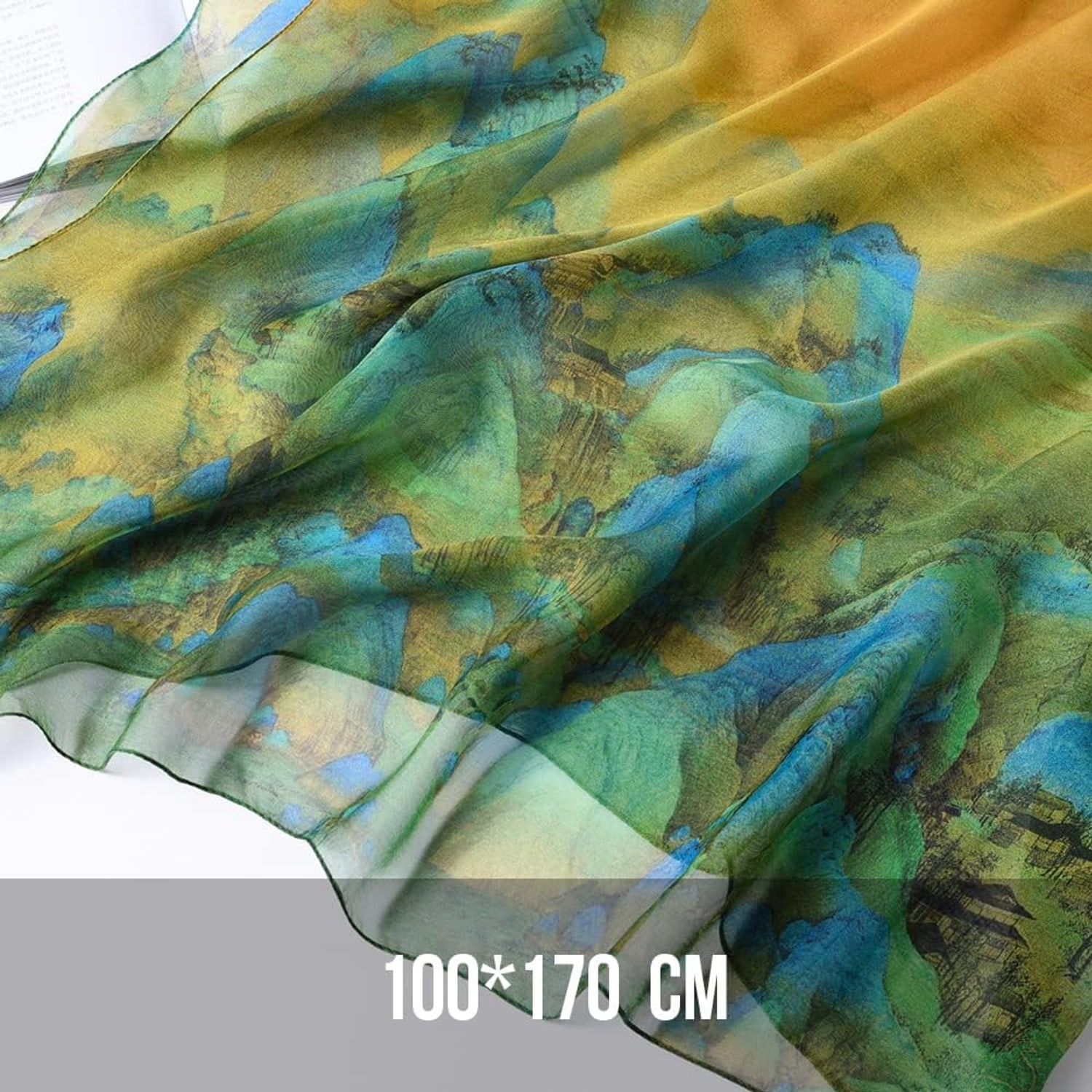
This one measures 67 x 43 inches (170 x 109 cm). The maker lists the fabric as 100% mulberry silk in a satin weave, and the design is a landscape painting print.
Why size matters more than you think
Scarves come in three rough families. Small squares, around 21 inches, sit at the neck and do very little else. Long skinny scarves, around 12 inches wide, loop at the neck and that is about it. Then there are large scarves like this one, cut wide as well as long, which can genuinely work as shoulder coverage.
The 43 inch depth is the number that matters. That is what lets the fabric sit across both shoulders and reach down over the upper arms. Anything much shallower slides off the back and sits like a collar instead of a wrap. The 67 inch width gives you enough length to cross the ends over at the front, knot them, or throw one end back over the opposite shoulder.
This is also why a large silk scarf is more flexible than a smaller one. You can always fold a big scarf down. You cannot make a small one bigger.
What mulberry silk and satin weave mean in practice
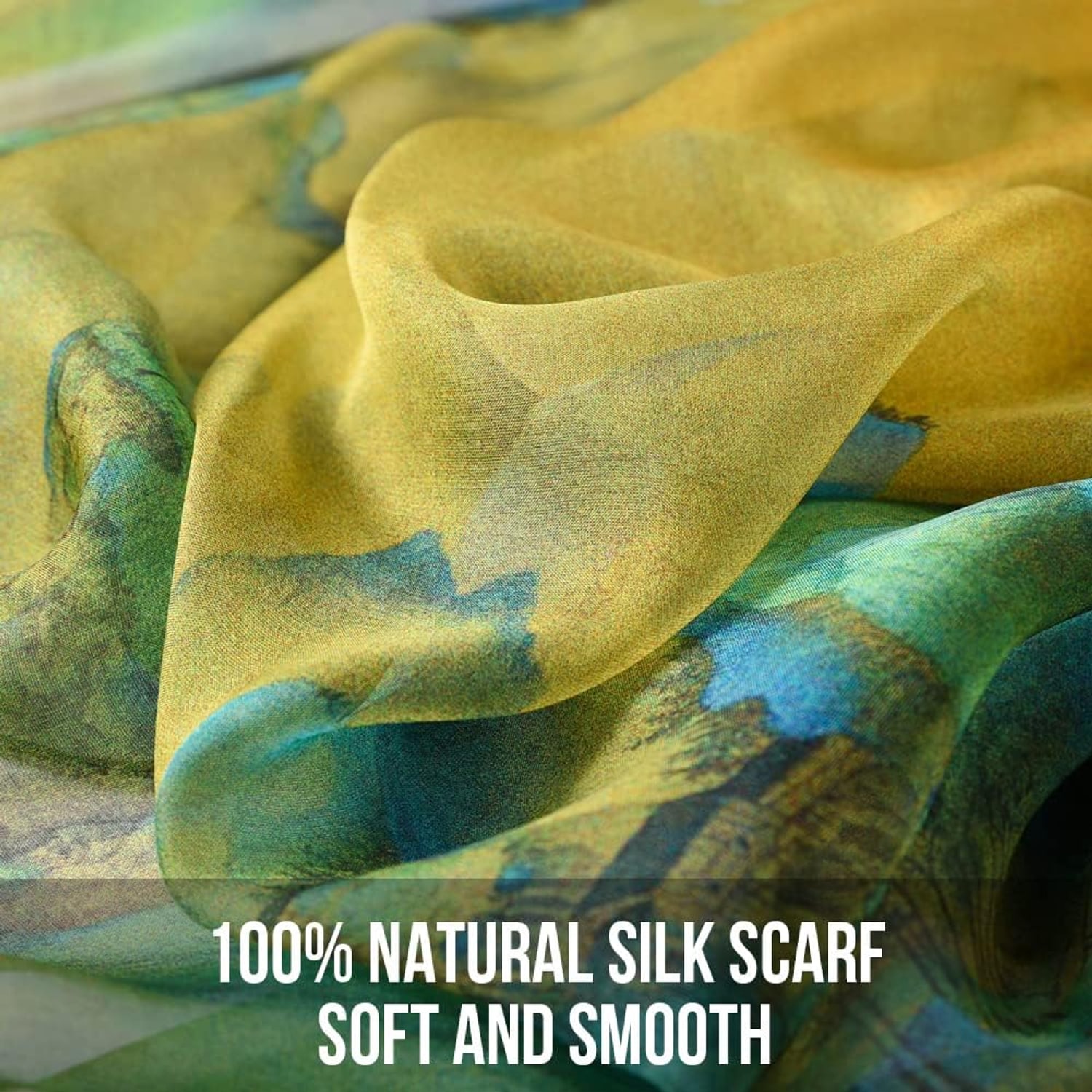
Mulberry silk refers to silk from silkworms raised on mulberry leaves. The filaments are long and even, which is why mulberry silk tends to have a smoother surface and a more uniform look than wild silks.
Satin weave is a separate thing. It describes how the threads cross each other. In a satin weave, each thread floats over several others before dipping under one. Those long floats on the surface are what catch the light and give the fabric its sheen, and they are also why the cloth feels slippery under your fingers.
Put the two together and you get what people mean when they say silk feels like silk. A smooth face, a soft fall and a fabric that slides over a coat sleeve or a knit instead of gripping it. Skin and hair move across it with less friction than they do across cotton, which is a simple physical fact about the surface, not a claim about anything else.
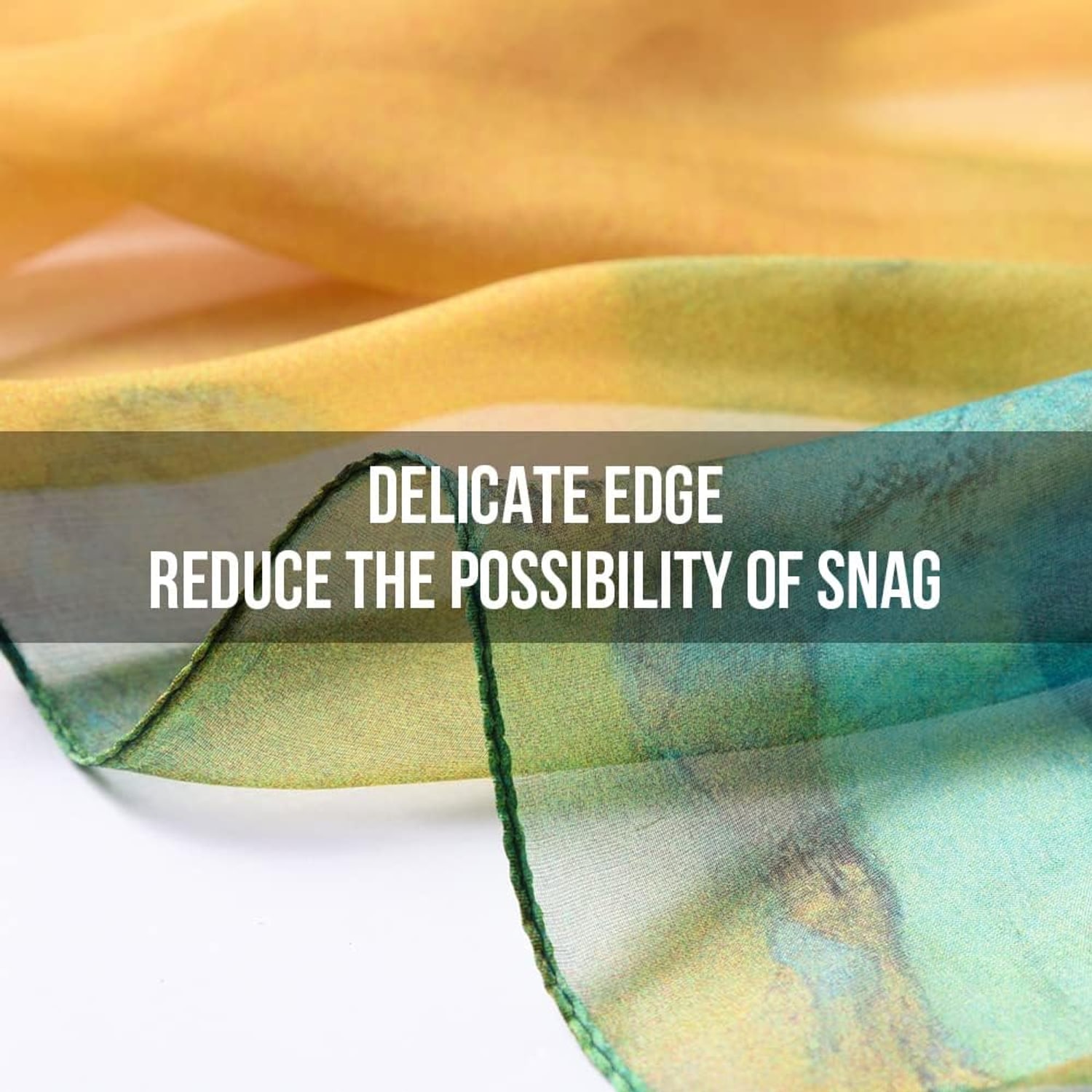
The flip side of satin weave is that it can snag. Long surface floats are more exposed than tightly bound ones. Rings with sharp settings, rough bag handles and Velcro are the usual culprits. It is worth knowing so you can be a little careful, not a reason to avoid it.
Who a wrap like this suits
If you dress mainly in plain colours, a printed silk wrap does a lot of work. Black coat, grey jumper, white shirt, navy dress. Any of those become more interesting the moment you add a landscape print across the shoulders, and you have not had to rethink anything else you own.
It suits travellers for the obvious reason. Lightweight silk packs to nothing. People who feel the cold indoors get good use out of it too, because offices and restaurants tend to run cooler than most people would choose, and a wrap you keep in your bag solves that without carrying a cardigan around.
It also works for anyone who needs shoulder coverage for an event. Weddings, outdoor dinners, places where a dress code or the simple drop in temperature after sunset means bare shoulders are not ideal.
Where it is less useful is real cold. This is lightweight silk. It is a layer for mild air and indoor chill. In winter it belongs under a coat or over a knit, not as the only thing between you and the weather.
How to wear it four ways
As a shawl. Open it flat, centre it across your back, and let the ends hang down the front. The simplest version and the one that reads most formal. A loose knot at chest height stops it sliding if you are moving around.
As a wrap. Same start, but throw one end back over the opposite shoulder. This frees up both arms and gives the drape more shape. Good for standing and talking.
As a head scarf. Fold it into a triangle first, or roll it into a wide band. Full size is too much fabric to tie around the head, but folded down it gives you plenty of options, from a full head covering to a band that holds hair back.
As a long neck scarf. Fold it lengthways into a band four or five inches wide, loop it once around the neck and let the ends hang. This is the version that disappears under a coat collar, and it is the one most people end up using day to day.
Choosing between prints and plains
A plain silk wrap is easy to match and easy to forget. A printed one does more, but it asks a bit more of you.
The useful trick is to look at the print and find the two or three colours that are doing most of the work. Pull your outfit from that family and the whole thing looks planned. A landscape print tends to be forgiving here because painted landscapes usually contain a wide spread of tones, so there is normally something in there that links to what you are already wearing.
If you are buying as a gift and you do not know the person's colour preference, a print gives you better odds than a solid shade. With a solid colour you either get it right or you do not. With a print there is more to connect to.
Caring for it
Hand wash only. That is standard for printed silk and it takes about five minutes.
Fill a basin with cool water and add a small amount of detergent made for delicates. Put the scarf in, swish it gently for a minute or two, and leave it no more than a few minutes. Do not soak it for hours. Rinse in clean cool water until the water runs clear.
Then the important part. Do not wring it or twist it. Lay it on a dry towel, roll the towel up with the scarf inside, and press to push the water out. Unroll and dry flat, away from direct sun and away from radiators. Heat and strong light are harder on silk than water is.
If it needs pressing, use the lowest heat setting with a thin cloth between the iron and the fabric, and work on the reverse side where you can. Steam held a few inches away relaxes most creases without any contact at all.
Day to day, let perfume and hairspray dry before you put the scarf on. Store it folded loosely or rolled, in a drawer or a soft pouch, not sealed in plastic for months on end.
The short version
This is a 67 x 43 inch (170 x 109 cm) wrap in what the maker lists as 100% mulberry silk, satin weave, lightweight, with a landscape painting print. The size is the point. It is wide enough to work as real shoulder coverage, and light enough that it folds small and lives in a bag.
Wear it as a shawl, a wrap, a head scarf or a folded neck scarf. Hand wash it in cool water, dry it flat, keep it off rough surfaces. Do that and a silk wrap like this stays in rotation for a long time.
If the colourway or the exact weight matters to you, check the photographs. Momme weight and country of origin are not specified, and we would rather say so than guess.