
The complete guide
Silk Scrunchies Buyer's Guide, How to Choose Size, Colour and Care
The small annoyance that adds up
Most people do not think about hair ties until something goes wrong. A thin elastic snaps at the worst moment. A tie with a metal crimp catches a few strands every time it comes out. You take your hair down at the end of the day and there is a hard dent across the ponytail that will not brush out.
None of these are big problems on their own. They are the kind of thing you put up with because a hair tie costs almost nothing and you have twelve of them in a drawer. But if you tie your hair up every day, the small annoyance happens three hundred times a year.
A silk scrunchie solves the mechanical part of that. It puts a smooth, closely woven fabric between the elastic and your hair, and it spreads the pressure across a wide band instead of a thin line. That is the whole idea. It is not complicated, and it works because of how the fabric behaves rather than anything clever in the design.
What makes silk different
Silk fibres are long, fine and even. When they are woven into fabric, the surface sits flat and reflects light, which is why silk has that soft sheen. More to the point here, a flat surface means less friction. Hair slides across it rather than gripping it.
Compare that with a cotton scrunchie. Cotton is a short staple fibre with a slightly fuzzy surface, which is lovely in a towel and less lovely when you are pulling hair across it. Nylon elastics are worse again, because the braided outer is deliberately textured so it grips. Grip is useful for holding a ponytail. It is not useful when the hold releases a few strands every time you undo it.
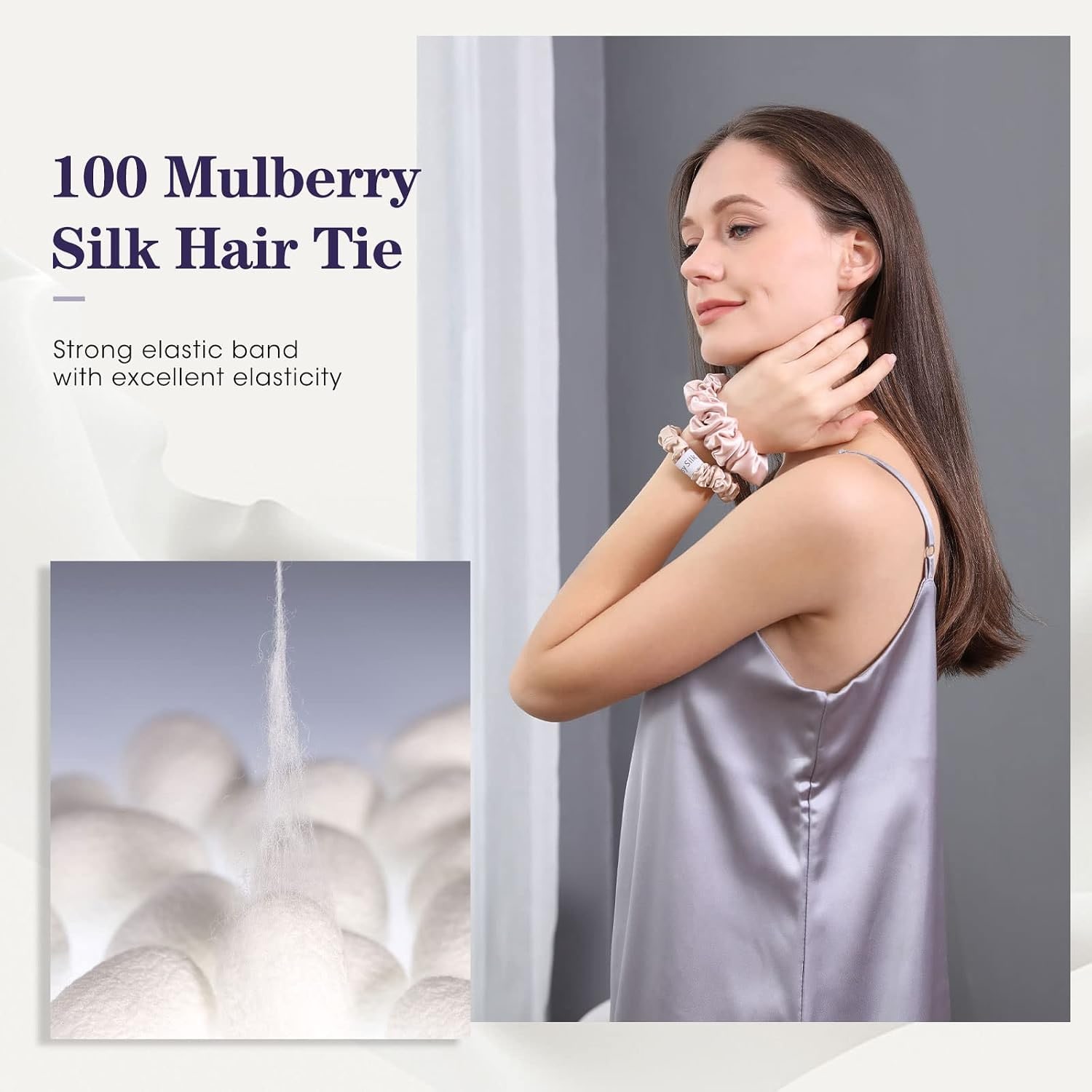
Mulberry silk is the most common silk used in clothing and bedding. It comes from silkworms raised on mulberry leaves, which produces long, consistent fibres and a smooth, uniform fabric. The scrunchies in this set are covered in 100% mulberry silk fabric with an elastic ring inside.
Why the size matters more than you think
Scrunchies come in small, standard and large, and the difference is not just how it looks.
Picture thick hair gathered into a ponytail. A small scrunchie has a short elastic and a narrow fabric tube, so you need four or five wraps to hold it. Each wrap stacks on top of the last, and the tension concentrates in a narrow band. That is the hold that gives you a headache by three in the afternoon and a visible dent at night.
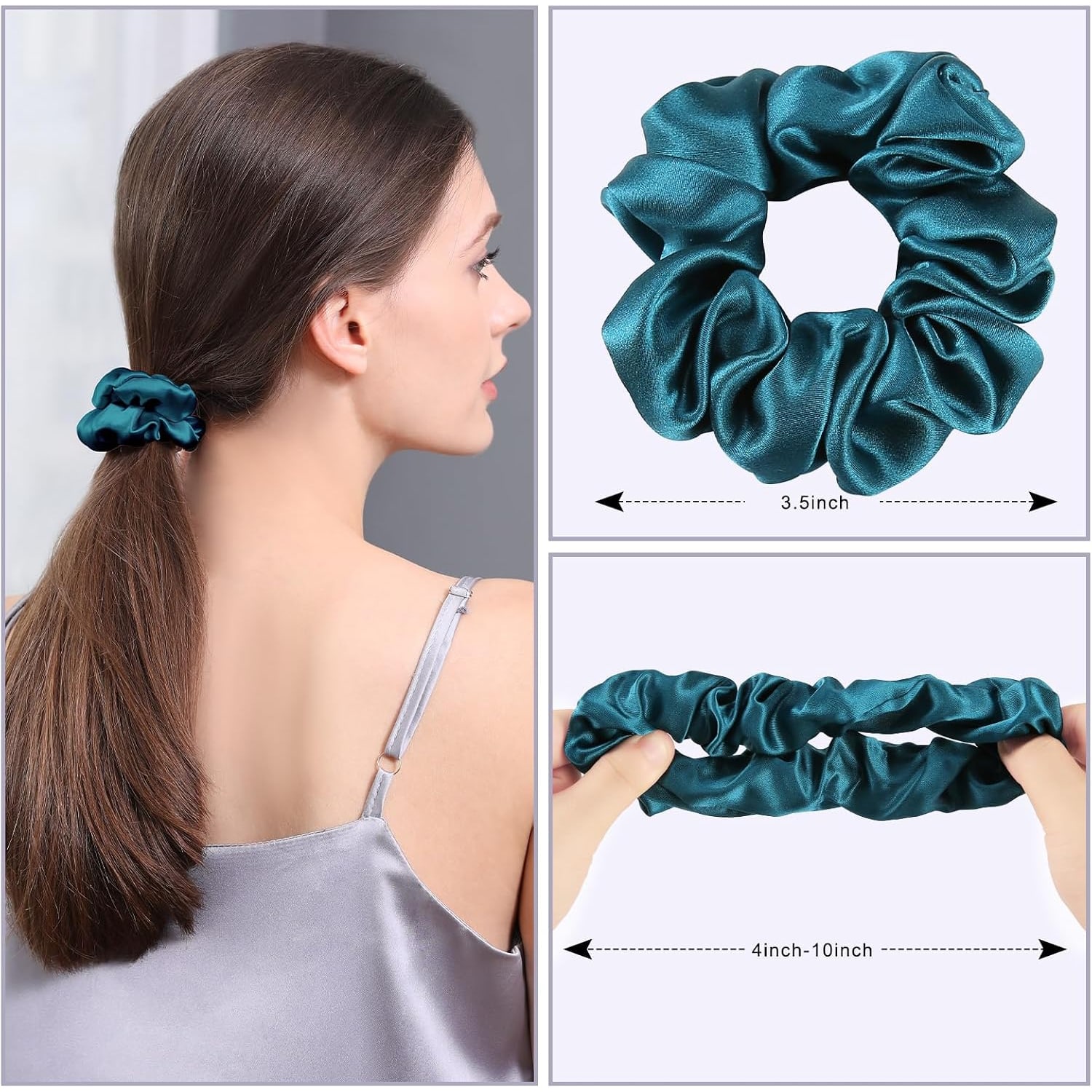
Now picture a large scrunchie. The fabric tube is wider and the elastic ring is bigger, so one or two turns do the job. The same amount of hold is spread over a wider area of hair. It feels gentler, it sits flatter, and it tends to look fuller because the fabric is supporting the base of the ponytail rather than strangling it.
These are large silk scrunchies, which puts them in the thick hair and long hair bracket. If your hair is fine, they still work. You just add a turn or two, and you get a bigger, softer looking bow of fabric at the base, which some people buy them for specifically.
The three colours and when you reach for each
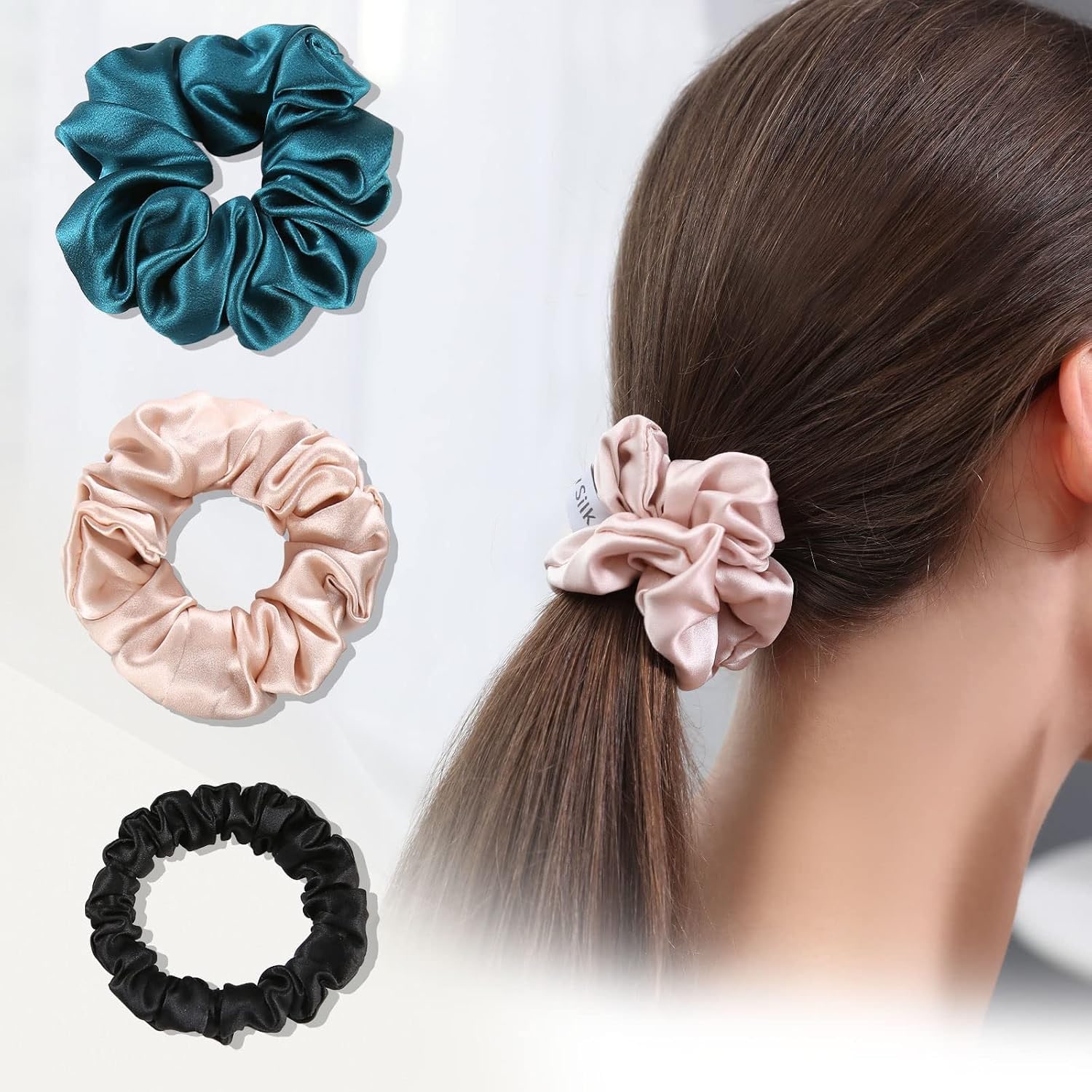
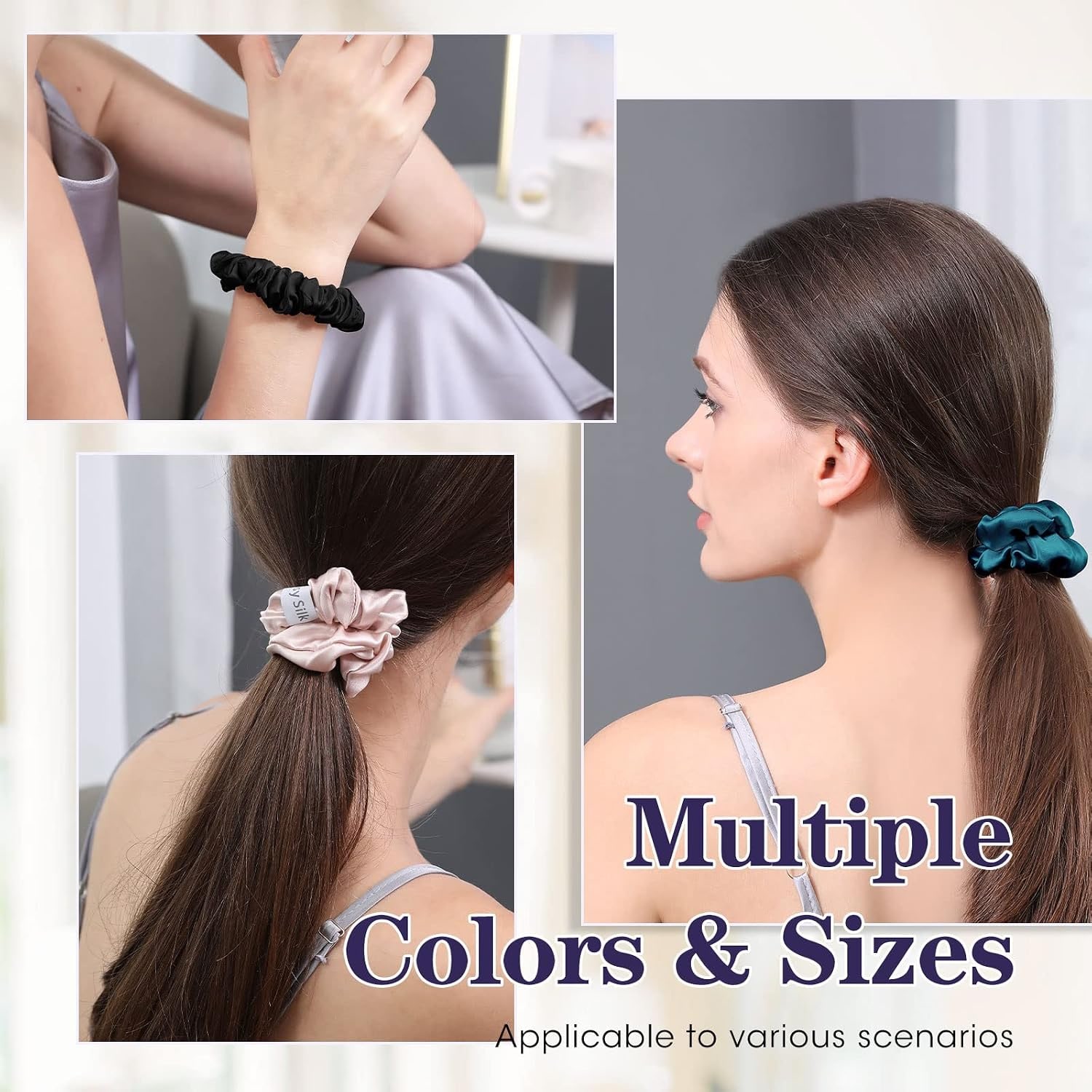
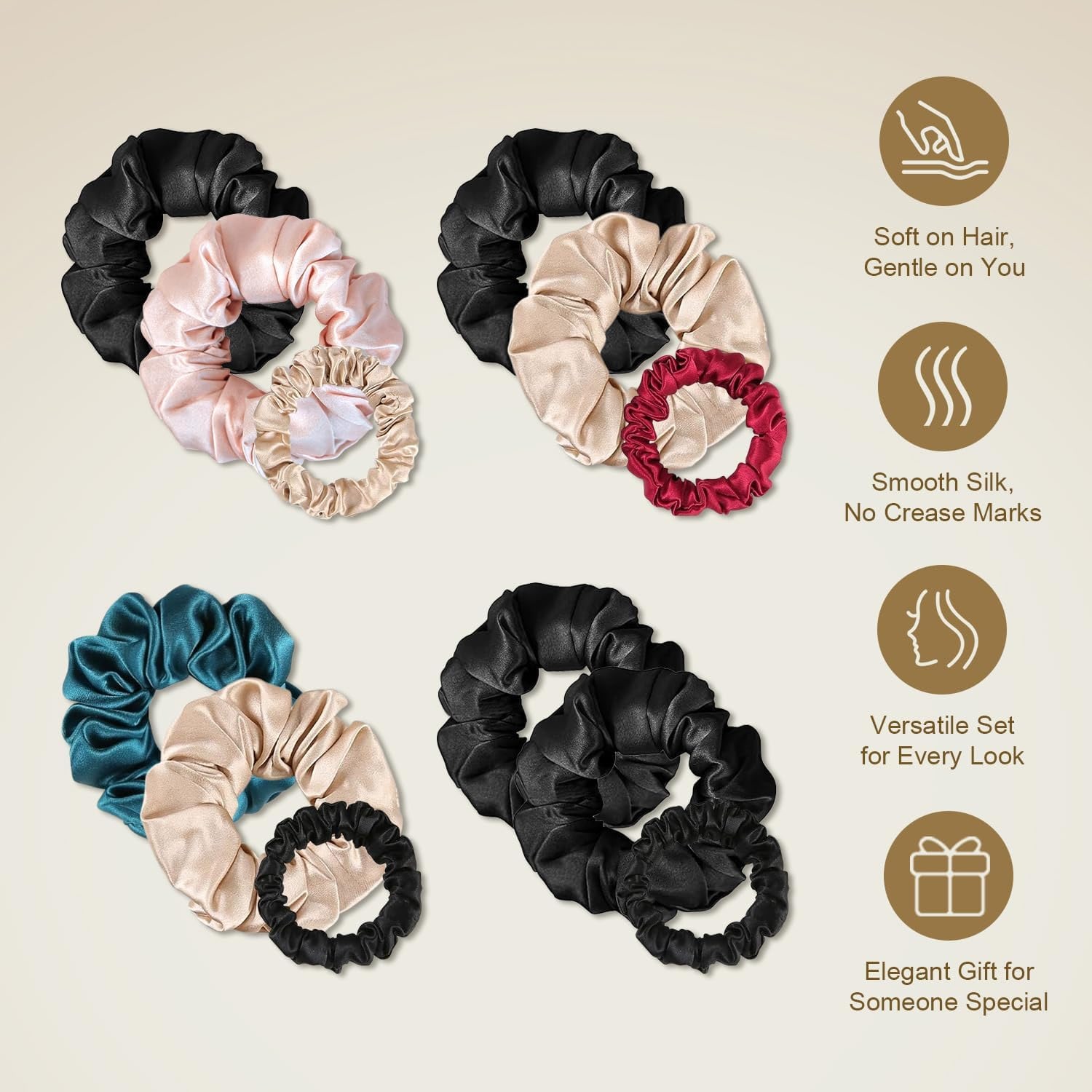
The pack has peacock blue, pink and black. That is a deliberate spread rather than three shades of the same idea.
Black is the workhorse. It disappears in dark hair, it goes with every outfit, and it is the one you keep in your bag. If you only wore one of the three, it would be this one.
Pink is the soft everyday option. It reads as a hair accessory rather than a piece of hardware, which matters when your hair is up for a whole day. It sits nicely against both light and dark hair.
Peacock blue is the one with presence. A rich teal blue catches the light in a way black never does, and silk amplifies that because of its sheen. This is the one for when the hair tie is part of the outfit rather than hidden inside it.
Having three also means you can rotate them. Elastic relaxes with use, and giving each one a rest between wears spreads that out.
Who these suit
If you have thick, long, curly or coily hair, large silk scrunchies are an easy recommendation. Those hair types catch on textured fabric more than straight fine hair does, so the smooth surface makes a noticeable difference.
They also suit anyone who wears their hair up for long stretches: shift workers, people in kitchens, anyone at a desk who ties it back at nine and takes it down at six. The wide band is more comfortable over hours than a thin elastic.
If you mostly wear your hair down and tie it up occasionally, a set like this still earns its place, but the difference will be less dramatic. And if you like a very tight, very sleek high ponytail that does not move, a large scrunchie is not the tool. For that look, a thin elastic underneath with a scrunchie over the top gives you both.
How to choose between scrunchies
A few things to look at, whichever ones you end up buying.
Check the silk content. The useful number is what percentage of the outer fabric is actually silk, and whether it is mulberry silk. These are 100% mulberry silk fabric on the outside.
Look at the elastic. A thick elastic ring holds its shape and gives the scrunchie structure. A thin cord inside a wide tube of fabric collapses after a few wears and stops holding properly.
Think about the number of turns your hair needs. If you are currently wrapping four or more times, size up. If you are wrapping once and it is still loose, size down or buy a set with mixed sizes.
Consider how many you need. People lose scrunchies. A three pack is a sensible starting point because it covers the main colour bases and you have a spare when one is in the wash.
Looking after them
Silk asks for a little care, but not much. Hand wash in cool water with a mild detergent made for delicates. Swirl it around, rinse, then press the water out between a folded towel. Do not wring and do not twist, because that is what puts permanent creases in silk.
Reshape it while damp and dry it flat, away from radiators, hair dryers and direct sunlight. Heat and strong sun are what dull the colour and the sheen.
Skip the bleach and skip the dryer entirely. If you want to machine wash, use a mesh bag on a cold delicates cycle, but accept that hand washing will keep them looking good for longer. If one comes out creased, a cool iron on the reverse side sorts it.
Wash them every week or two with regular use. Hair products and oils build up in the weave, and once they do, the silk stops feeling slippery and starts feeling slightly tacky.
The short version
These are three large scrunchies covered in 100% mulberry silk fabric, in peacock blue, pink and black, with a thick elastic ring inside each one. The silk surface is smoother than cotton or nylon, so hair slides across it instead of catching. The large size means fewer wraps and wider, gentler pressure, which is what thick and long hair wants.
Hand wash in cool water, dry flat, keep them out of the dryer and out of direct sun. Rotate between the three and they will last a long time. If the size turns out to be wrong for your hair, get in touch and we will point you to something that fits better.