
The complete guide
How to Choose a Long Silk Scarf That You Will Actually Wear
The scarf problem most people have
Most of us own scarves we never wear. They sit in a drawer because they are too bulky for indoors, too scratchy against the neck, too bright to pair with anything, or the wrong shape for the way we actually dress. The scarf that gets worn is almost always the one that solves a small daily problem without making a fuss about it.
That problem is usually this. You leave the house in a jacket, spend the day in a building that runs cold, and go out in the evening when the temperature drops again. Heavy knitwear is wrong for two of those three moments. A long silk scarf is right for all of them, because it adds a layer at the throat and shoulders without adding bulk, and because you can take it off and push it into a bag without ruining the look of your outfit.
This guide covers what to look for in a long silk scarf, how the size and weave affect the way it wears, and how to keep one looking good for years.
What makes silk different
Silk is a protein fibre, spun as a single long filament rather than a short staple like cotton or wool. That length is why silk cloth comes out smooth. There are fewer fibre ends poking up from the surface, so there is less to scratch and less to catch on your skin or your hair.
Mulberry silk is the grade you want. It comes from silkworms fed a controlled mulberry leaf diet, which produces unusually even, unusually long filaments. The result is a more consistent cloth with better colour uptake. This scarf is listed as 100% mulberry silk.
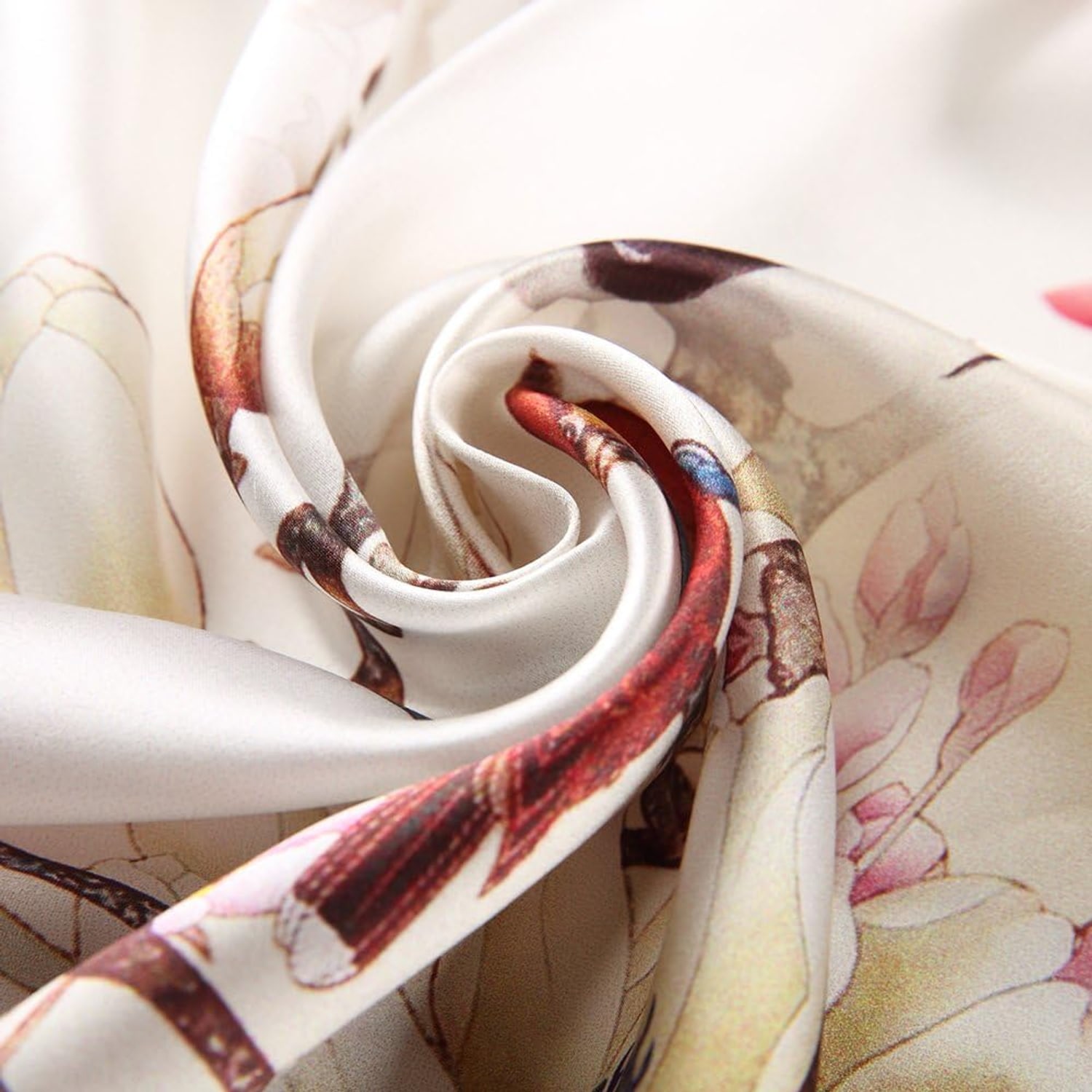
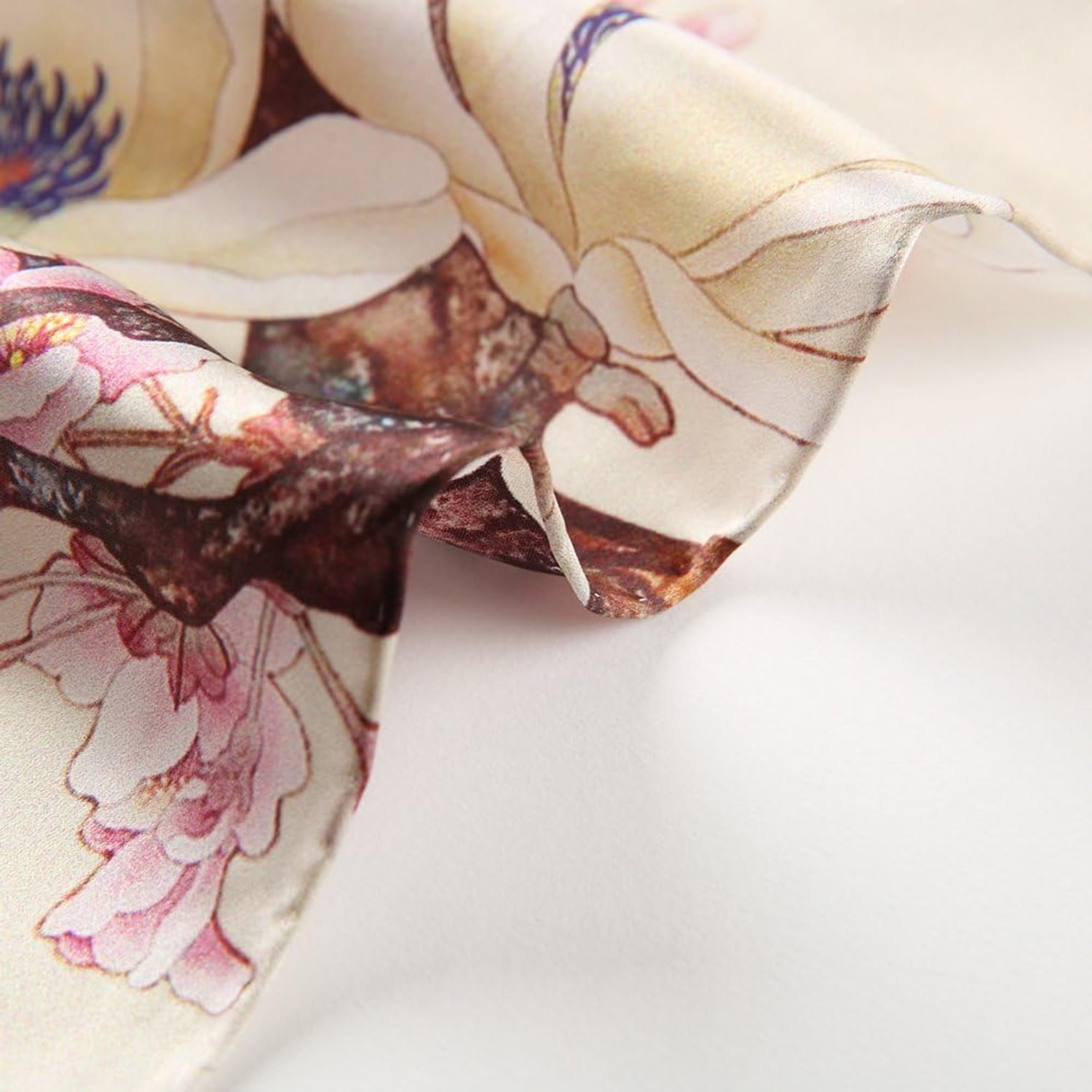
Then there is the weave, which people often confuse with the fibre. Satin is a weave structure. In a satin weave, each thread passes over several threads before dipping under one, so most of the yarn sits on the surface. That gives you the smooth face and the soft shine. It also changes how the cloth behaves. Satin slides over itself, which is why knots in a satin weave scarf pull neat and release without a hard crease.
A chiffon or georgette weave in the same fibre feels completely different, more textured and more airy. Neither is better in the abstract. Satin is the one you pick when you want the scarf to look smooth and to drape in soft columns rather than crinkle.
Size, and why the long rectangle wins
Scarves come in three broad shapes. The square, usually 35 inches or so, is the classic. It folds into a bias band for the neck, or sits as a kerchief over the hair, but it is fiddly to drape and it does not loop well.
The skinny oblong, narrow and short, is a trim accessory. It adds a line of colour and nothing else. It cannot act as a wrap.
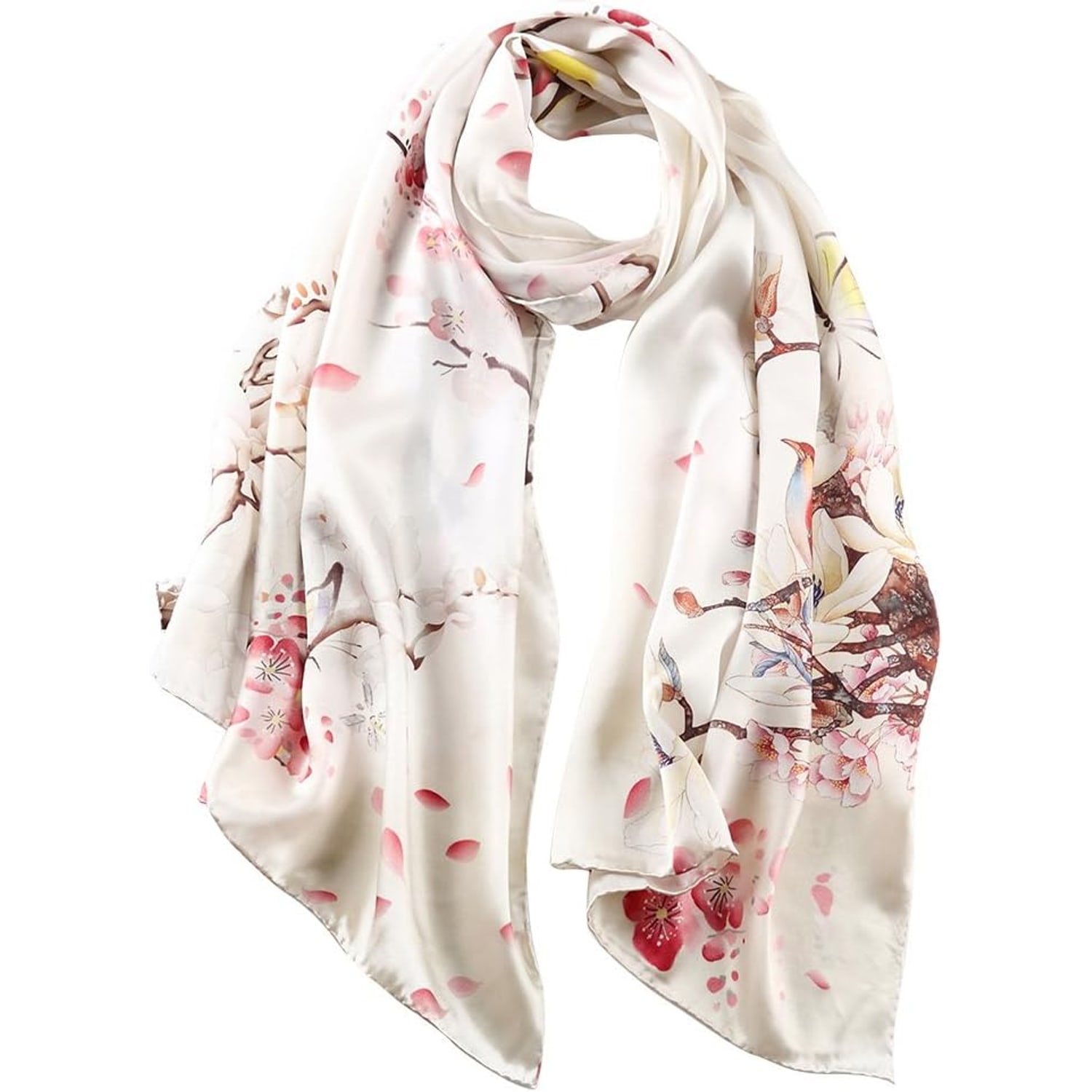
Then there is the long rectangle, which is what this one is. At 67 x 21 inches (170 x 53 cm) it covers the widest range of uses. That length loops twice round the neck with ends to spare, ties as a head scarf with room to knot at the nape, and opens out as a light shawl across the shoulders. The 21 inch width is the part people underestimate. A narrow oblong will not cover shoulders. This one will.
If you are weighing up the best long silk scarf for your wardrobe, measure the length against what you want it to do. Anything under about 60 inches starts to limit the double loop on an average adult neck. Anything over about 75 inches begins to get unwieldy unless you want a dramatic open drape.
Who it suits
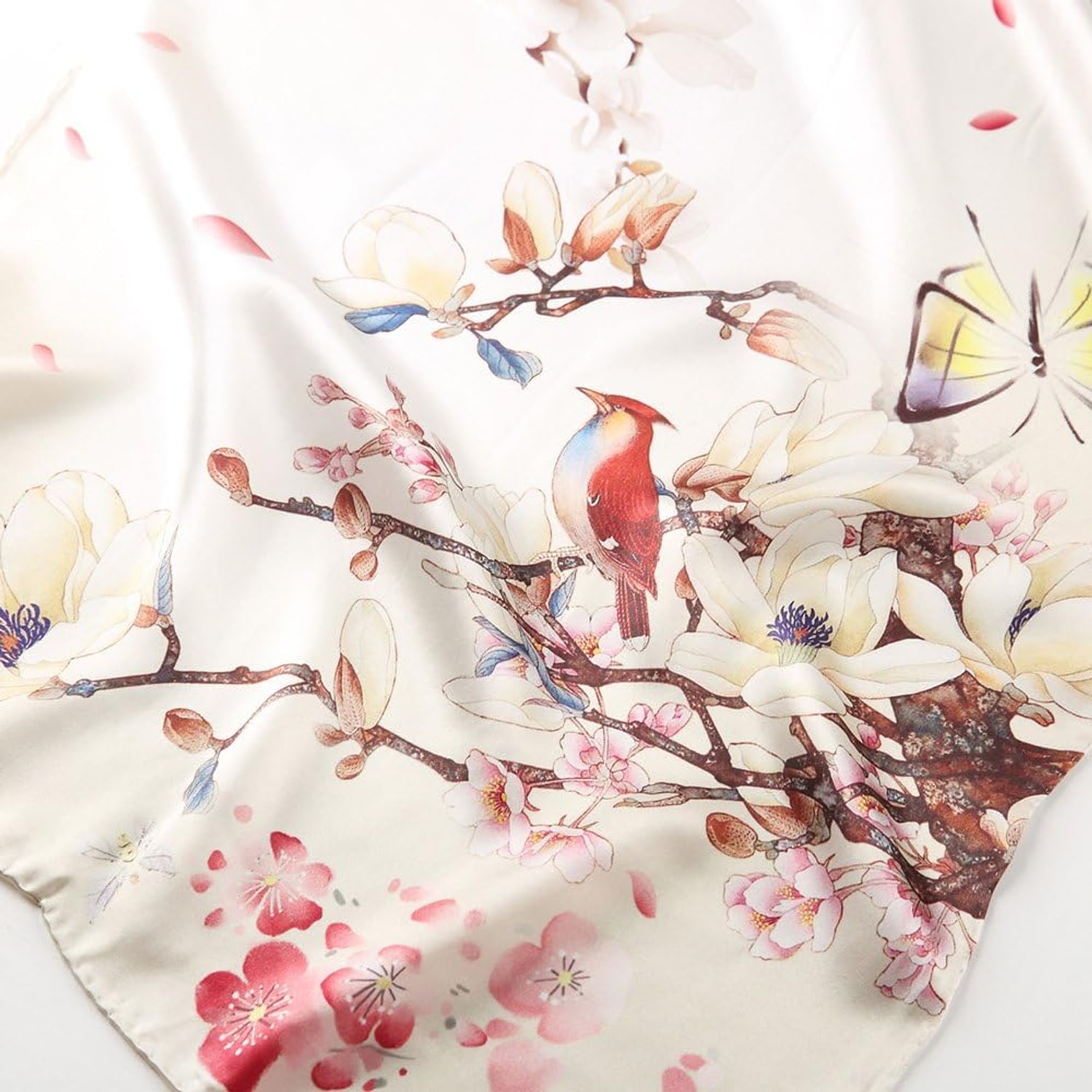
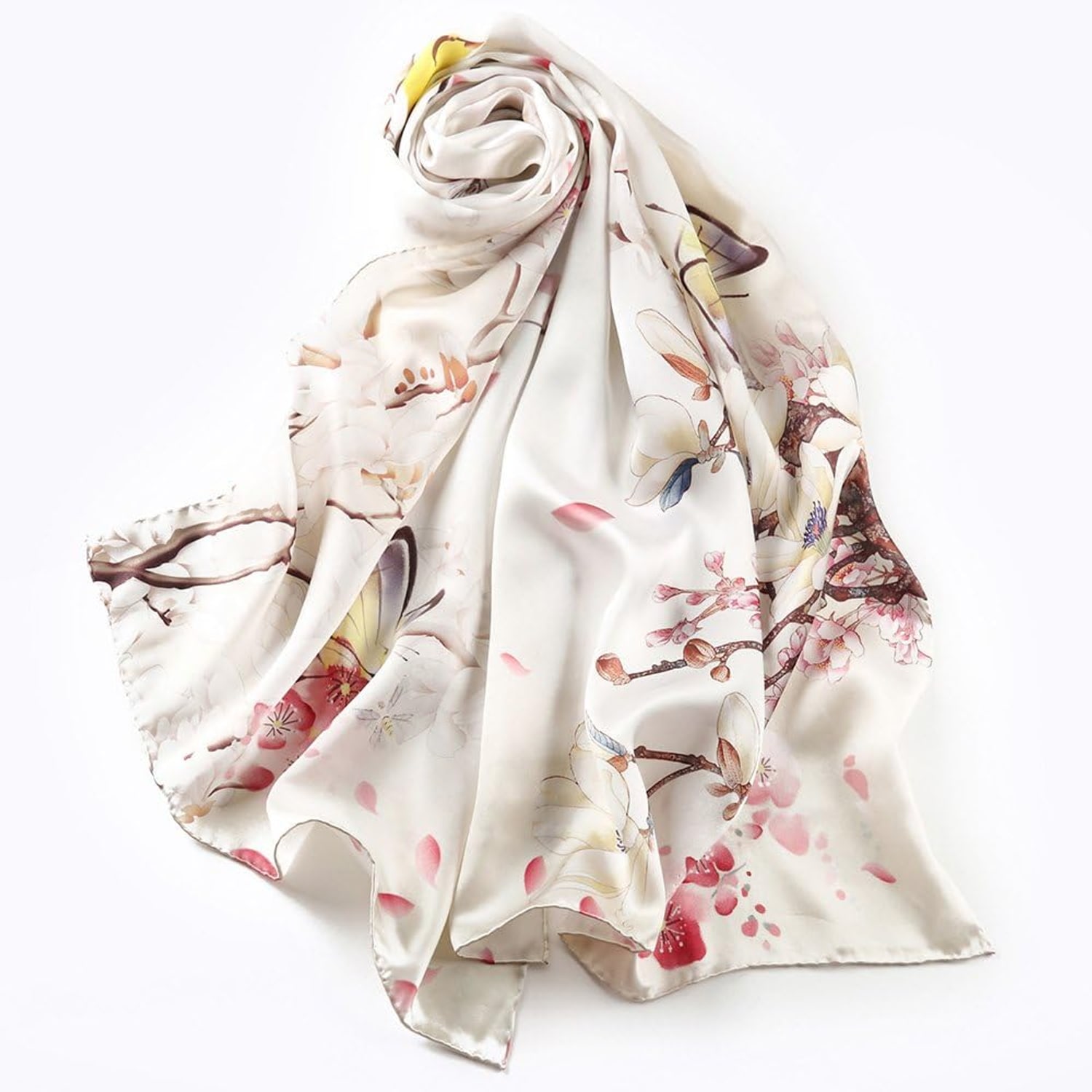
This one suits you if you wear a lot of plain colour and want one accessory that lifts the whole outfit. The pink blossom print on cream is soft, so it does not fight with what it sits on. It is a natural partner for navy, charcoal, black, camel and denim.
It suits you if you are often too warm for wool and too cold without anything. Silk is the in-between layer. It takes the edge off a draughty room without making you overheat on the walk home.
It suits you if you travel. A silk scarf rolls into nothing, doubles as a shoulder cover on a plane, and can turn a plain travel outfit into something presentable when you arrive. People who have hunted for the best lightweight silk wrap for packing usually end up with a long oblong for this reason.
It suits you if you tie your hair back and dislike the way rough fabric pulls at it. Silk is smooth, so hair slides over it with less friction than cotton.
It is less right for you if you want serious warmth. This is not a winter wrap. Over a coat it is decorative and adds a small amount of insulation at the neck, but on a freezing day you will want wool underneath or over the top.
How to choose between prints and plains
A plain silk scarf is the safer buy in theory and the more boring one in practice. Plains tend to stay in the drawer because they add nothing you could not get from a sweater in the same colour.
A print earns its place by doing something your clothes cannot. The test is whether the print has a dominant neutral in it. Here the ground is cream, which means the eye reads the scarf as light and soft before it reads it as floral. That is what makes a print wearable with multiple outfits instead of one.
Scale matters too. Very large motifs can swamp a small frame when the scarf is folded, because you only see part of the design. Branch and blossom prints tend to work well folded, since the pattern repeats across the cloth rather than sitting in one big block.
If you want a second scarf later, go in a different direction rather than a near-match. A plain deep colour or a geometric will cover the gaps a floral leaves.
Looking after it
Hand wash only. This is the single rule that matters. Fill a basin with cool water, add a small amount of detergent made for delicate fibres, and move the scarf through the water gently with your hands. Do not rub, do not scrub, and do not leave it soaking for half an hour.
Rinse in clean cool water until there is no slip left in the fabric. Lift it out supporting the whole weight, because wet silk is weaker than dry silk and a hanging corner can stretch.
Never wring it. Lay the scarf flat on a clean towel, roll the towel up with the scarf inside, and press. That removes most of the water in about thirty seconds. Then dry it flat, or hang it over a rail somewhere shaded and airy. Direct sun is the fastest way to dull a printed colour.
If you need to press it, use the lowest setting your iron has, work on the reverse side, and keep the iron moving. A thin cotton pressing cloth between the iron and the silk is cheap insurance. Avoid blasting steam straight onto the printed face.
Two small habits extend the life of any silk scarf. First, get dressed before you spray perfume or hairspray, since alcohol-based sprays can mark the fibre. Second, take off chunky rings before you tie it, because the most common damage to satin weave silk is a snag from jewellery, not from washing.
Store it folded loosely or rolled, in a drawer or a soft pouch. Hanging it on a thin hook for months can leave a stretch line you will not get out.
Styling it three ways
The loop is the default. Fold the scarf in half lengthways, put the folded loop over one shoulder and the two ends over the other, then pull the ends through the loop and tighten to taste. It takes four seconds and looks deliberate.
The open drape works under a coat. Lay the scarf flat around the back of the neck with both ends hanging down the front at equal length, then close the coat over it. You get a vertical line of colour down the middle and no bulk at the throat.
The shoulder wrap is for evenings. Open it out fully, lay it across both shoulders and let it fall. At 21 inches wide it covers enough to be useful in an air-conditioned room, and you can tie the ends loosely at the front if it keeps sliding.
As a head scarf, fold a hem under at the front edge, place it over the hair, and tie at the nape or under the chin. The 67 inch length leaves plenty of tail.
The short version
A long silk scarf earns its place by being the layer you can wear all day. This one is 100% mulberry silk in a satin weave, 67 x 21 inches (170 x 53 cm), printed with pink blossom on cream. That size loops, wraps, ties and drapes, and the soft print pairs with the plain colours most people already wear.
Care is hand wash only, cool water, no wringing, dry flat in the shade. Follow that and it stays in rotation for years. Brand, momme weight and country of origin are not specified for this item, so we have not claimed them. Everything above is based on the fibre, the weave, the measurements and the print, which is what you actually feel when you put it on.