
The complete guide
How to Choose a Queen Silk Pillowcase, Without Overthinking It
The part of the bed nobody shops for
People spend weeks on a mattress. They read reviews, lie on showroom beds, compare foam densities. Then they put a cotton pillowcase on top that cost eight dollars and never think about it again.
That is strange when you consider the arrangement. Your face is pressed against that one piece of cloth for about a third of your life. Everything else in the bed is under you or over you. The pillowcase is the only fabric that spends the whole night touching your cheek and your hair.
A silk pillowcase is a small change to the smallest part of the bed. It does not require new sheets, a new duvet, or a new colour scheme. You take off one pillowcase and put on another.
What momme actually tells you
Silk is sold by momme, which is a weight measure. One momme is about 4.3 grams per square metre. The higher the number, the more silk is packed into the same area of cloth.
Bedding silk usually lands somewhere between 16 and 25 momme. Below about 16 the fabric starts to feel thin and insubstantial, and it tends to shift around on the pillow rather than lying flat. Above about 25 you are paying considerably more for a cloth that some people find too warm and too heavy for a pillow.
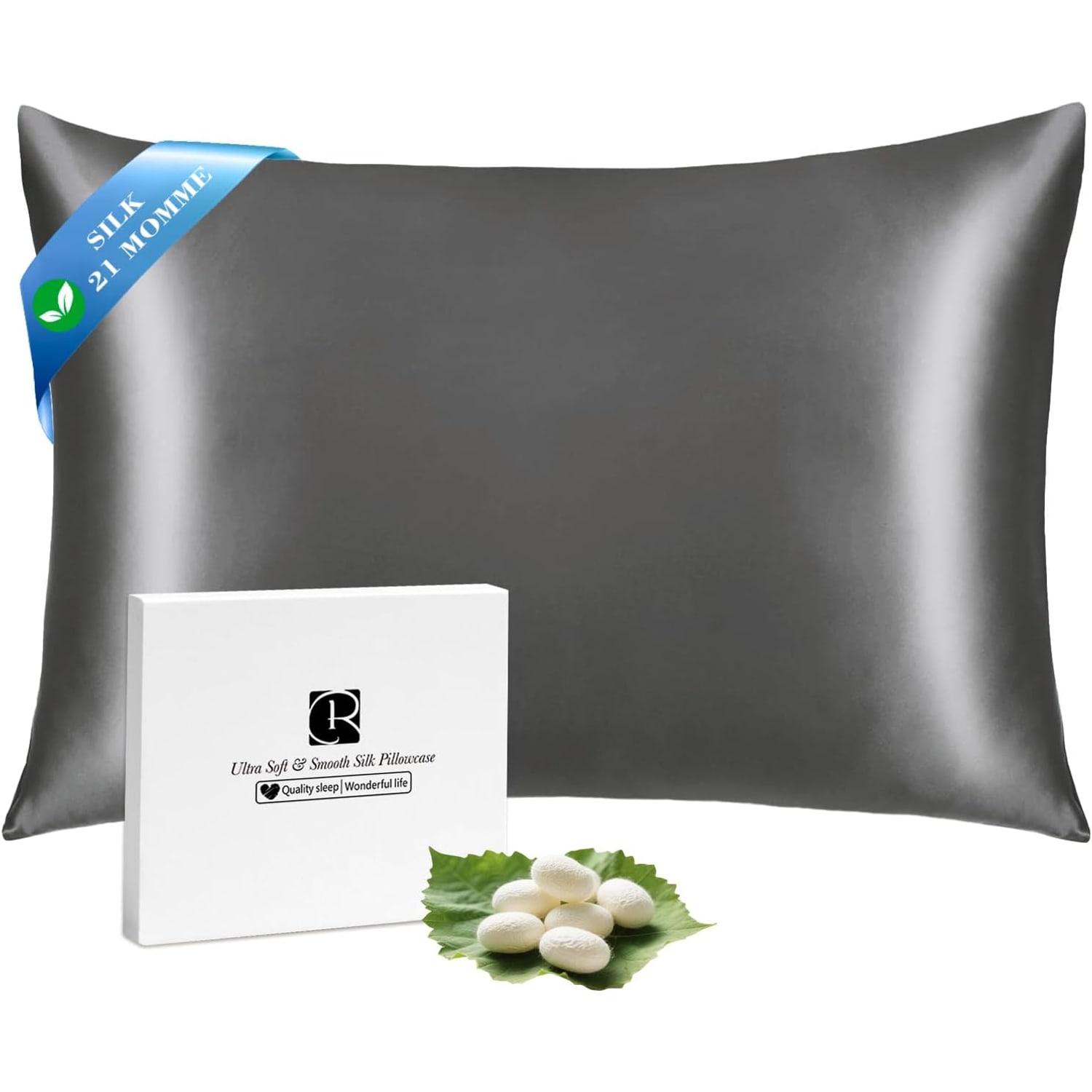
This pillowcase is 21 momme. It is not the lightest and not the heaviest. In practice that means the fabric has enough body to drape over the pillow properly, holds a smooth surface instead of rucking up, and still feels cool and fluid when you first put your head down. If you have been reading around trying to find the best mulberry silk pillowcase and keep seeing momme numbers thrown about without explanation, 21 is a safe landing spot.
Momme is not the same as thread count, and the two are not interchangeable. A silk pillowcase advertising a thread count rather than a momme weight is usually hiding something.
Mulberry silk and why the word matters
Not all silk comes from the same place. Mulberry silk is produced by silkworms fed exclusively on mulberry leaves, in controlled conditions. The result is a long, continuous, even filament.
Other silks, such as tussah, come from wild moths and produce shorter, more irregular fibres. They have their own character and their own uses, but they do not give you the same uniform smoothness. For a pillowcase, where the entire point is an even surface, long filaments matter.
This case is 100% mulberry silk on both faces. That second detail is worth pausing on. A fair number of silk pillowcases on the market use silk on the top face and a cotton or polyester back, which keeps the cost down. You notice immediately when you flip the pillow over at two in the morning. Both sides here are the same cloth.
The friction question
Here is the honest version of why people switch. Cotton is woven from short staple fibres and the weave has a slight texture to it. When you turn your head, your hair and your skin catch on that texture a little. It is a tiny amount of drag, repeated hundreds of times a night.
Silk filaments are long and the surface is smooth and even. Hair and skin slide across it instead of catching. That is a straightforward physical difference and it is the main reason people with long hair in particular go looking for the best silk pillowcase for long hair rather than just buying another cotton one.
We are not going to tell you what that does for your skin or your hair beyond the friction itself. Plenty of websites will. The measurable fact is the smoothness, and it is real.
Zipper versus envelope
Pillowcases close one of two ways. An envelope style has an overlapping flap of fabric that tucks the pillow in. A zipper runs along one edge and seals it shut.
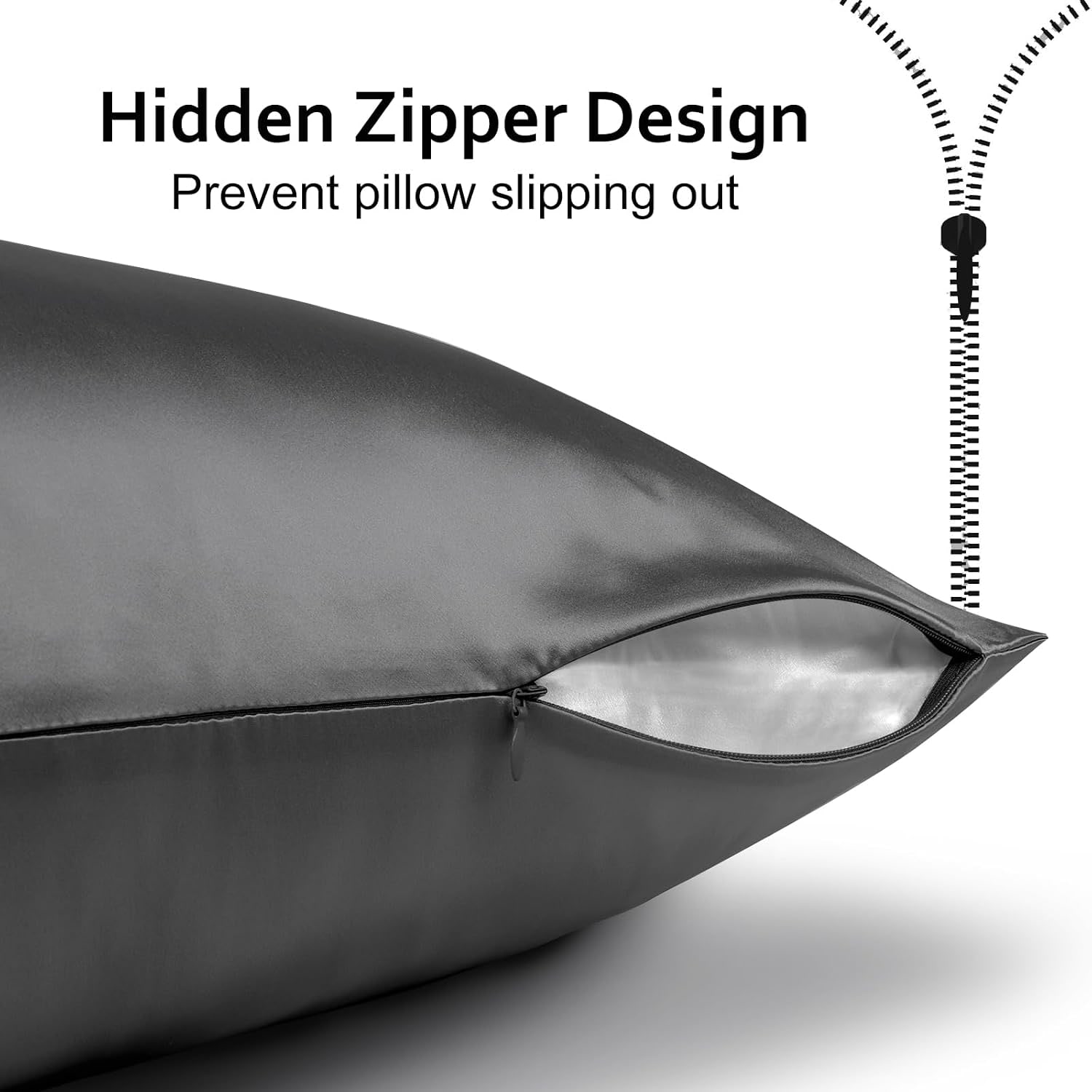
Envelope closures are cheaper to produce and they are perfectly fine on a cotton case that you do not mind re-tucking. On silk they are less convincing, because the fabric is slippery and the flap has nothing to grip. Over a night of turning over the pillow works its way out, and you wake up with the corner of a bare pillow poking out of the case.
This one uses a hidden zipper. The pillow goes in, you close it, and it stays closed. The zipper is set along one short edge and tucked under fabric, so it does not sit where your head rests. It also keeps the case from turning itself inside out in the washing machine, which matters more than you would think. If you have been comparing the best hidden zipper pillowcase options, this is the construction you want.
Getting the size right
Canadian pillow sizing is straightforward once you know the three numbers. Standard is 20 x 26 inches. Queen is 20 x 30 inches, or 51 x 76 cm. King is 20 x 36 inches.
This pillowcase is a queen. Before you order, lay your pillow flat and measure it across and down with a tape. Do not guess from the bed size, because people often use standard pillows on a queen bed and queen pillows on a king bed.
If your pillow is a little smaller than 20 x 30 you will have some slack at one end, which is harmless. If your pillow is bigger, the case will be stretched tight and the seams and zipper will take the strain. In that situation, size up rather than squeezing it in.
Depth matters too. A thick contoured foam pillow takes up more of the case than a flat feather one of the same length and width. If your pillow is unusually deep, allow for that.
Living with silk
Silk has a reputation for being fussy. Most of that reputation comes from garments with linings and structure, not from a flat rectangle of cloth.
Wash this on a delicate or hand-wash cycle in cool water, inside a mesh laundry bag. The bag is the part people skip and it is the part that matters, because it stops the case from tangling with zips and buttons on other items. Use a mild detergent made for silk or wool.
Stay away from bleach, fabric softener and anything with optical brighteners in it. Softener does nothing useful on silk and leaves a film. Brighteners affect the colour.
Then air dry, flat or hanging, out of direct sun. It dries quickly. A dryer will get the job done but the heat shortens the life of the fibres, and silk is not an item you want to replace every year. If you want it crisp, press it on a cool setting from the reverse while it is still slightly damp.
Washing weekly is normal. If you use hair oil or a heavy night cream, wash it more often, because oils sit on silk rather than soaking in.
Who this suits
People with long hair who are tired of waking up to a nest. People who find cotton feels rough by the end of a hot night. People who have already upgraded the mattress and the duvet and are wondering what is left.
It also makes a genuinely good gift, which is worth noting. Silk bedding is one of those things most people enjoy but rarely buy for themselves, and the space grey colour avoids the problem of guessing someone's taste. It goes with white, it goes with navy, it goes with patterns.
Who it does not suit: anyone who wants a wash-and-tumble-dry item they never have to think about. Silk needs a cool wash and a line, and if that sounds like too much, a good cotton percale will serve you better.
The short version
Twenty-one momme is a sensible mid-weight for a pillowcase. Mulberry silk on both sides means you do not have a cotton back waiting to disappoint you. A hidden zipper keeps the pillow where it belongs. The queen cut is 20 x 30 inches, so measure your pillow before you order.
Wash it cool in a mesh bag, hang it to dry, keep softener away from it, and it will stay smooth for a long time. One pillowcase per order, so buy two if you want the pair.