

The complete guide
Choosing King Silk Pillowcases, A Practical Buyer's Guide
The small annoyance nobody talks about
Most people do not lie awake thinking about their pillowcase. They just notice the result. Hair that has knotted itself against the fabric overnight. A cheek that feels dragged on when you roll over. A cotton case that was crisp when you made the bed and is warm and rumpled by two in the morning.
Woven cotton, even good cotton, has texture. Thousands of tiny thread crossings make a surface that grips. That grip is what tugs at hair and pulls at skin as you move during the night, and you move more than you think, roughly every twenty minutes.
Silk does not grip in the same way. The filament is long and smooth, and the woven surface reflects that. Hair and skin slide across it instead of catching. That is the honest, mechanical reason silk pillowcases took off, and it is the only claim worth making about them.
What you are actually buying
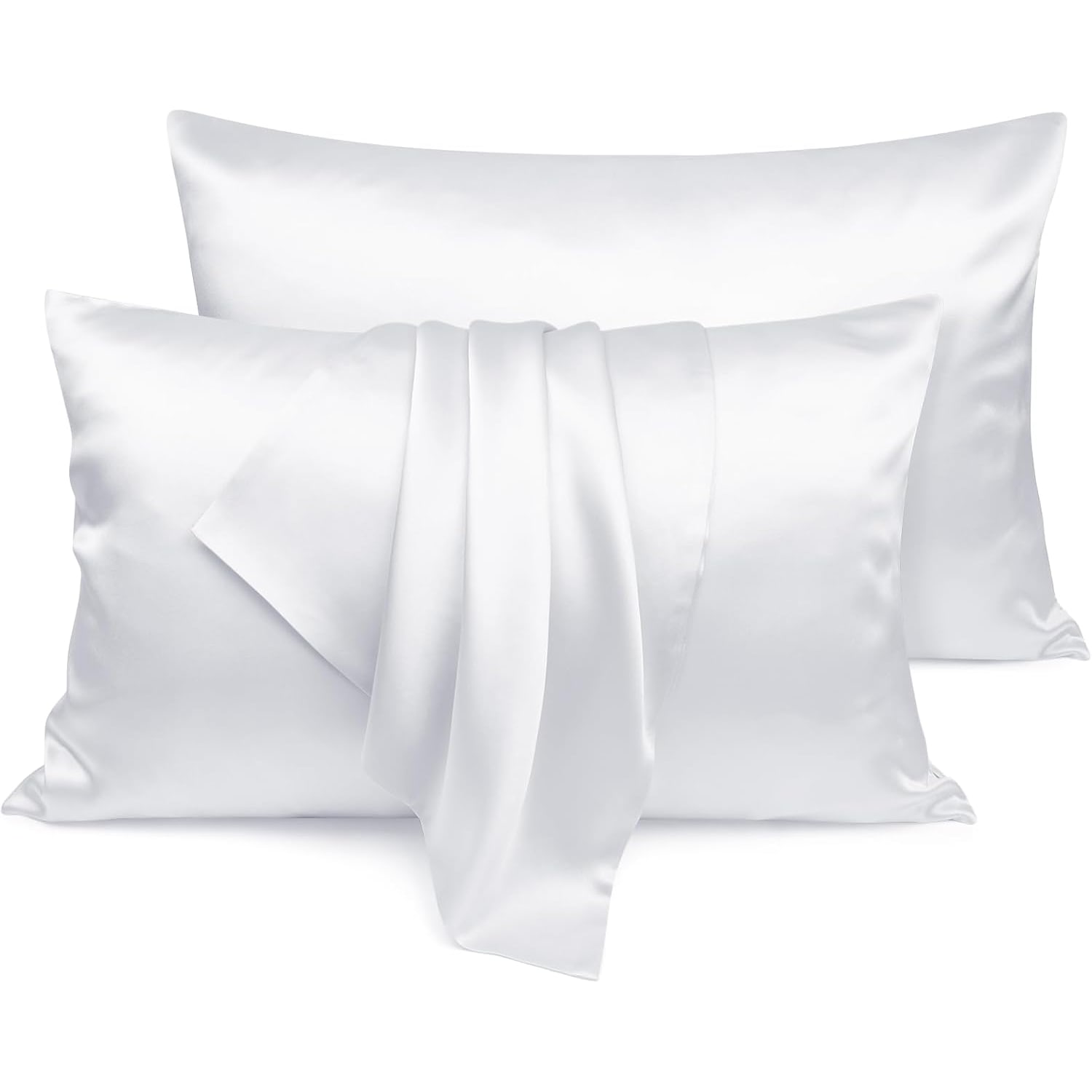
This set is two white pillowcases in king size, 20 x 36 inches (51 x 91 cm), made from 100% mulberry silk graded 6A. Both sides are silk. There is no cotton reverse, which matters more than it sounds, because a case with a cotton back only works if you remember which way up it is.
Mulberry silk is the type produced by silkworms raised on a mulberry leaf diet. The filaments come off the cocoon long and even, which is what lets a mill reel them into continuous yarn rather than spinning short staples together. Grade 6A is a mill grading for that yarn, describing consistency and few breaks. It is a yarn quality measure, not a thickness measure.
Thickness is described separately, in momme. The maker does not state a momme weight for this set, so if you are shopping with a specific number in mind, treat that figure as unknown here rather than assuming it.
Getting the size right
This is where most pillowcase returns come from, so it is worth two minutes.
Pillow sizes are defined by length, not by the bed. A standard pillow is 20 x 26 inches. A queen pillow is 20 x 30 inches. A king pillow is 20 x 36 inches. All three are the same width.
So a king case fits a king pillow. It will also go over a queen pillow, but you end up with roughly six inches of empty silk flapping at one end. Some people genuinely like the soft draped look that creates, particularly on a made bed with a throw across the foot. Most people find it annoying, because the pillow slides around inside the case.
Pull a case off one of your current pillows and measure the pillow itself with a tape. Do not measure the case, which is usually cut slightly larger. If the pillow is around 36 inches long, this set is the one you want. If it is closer to 30, you want queen instead.
Why the zipper matters more on silk
Pillowcases close one of two ways. An envelope flap folds a panel of fabric back over the open end. A zip runs along a seam and shuts the case completely.
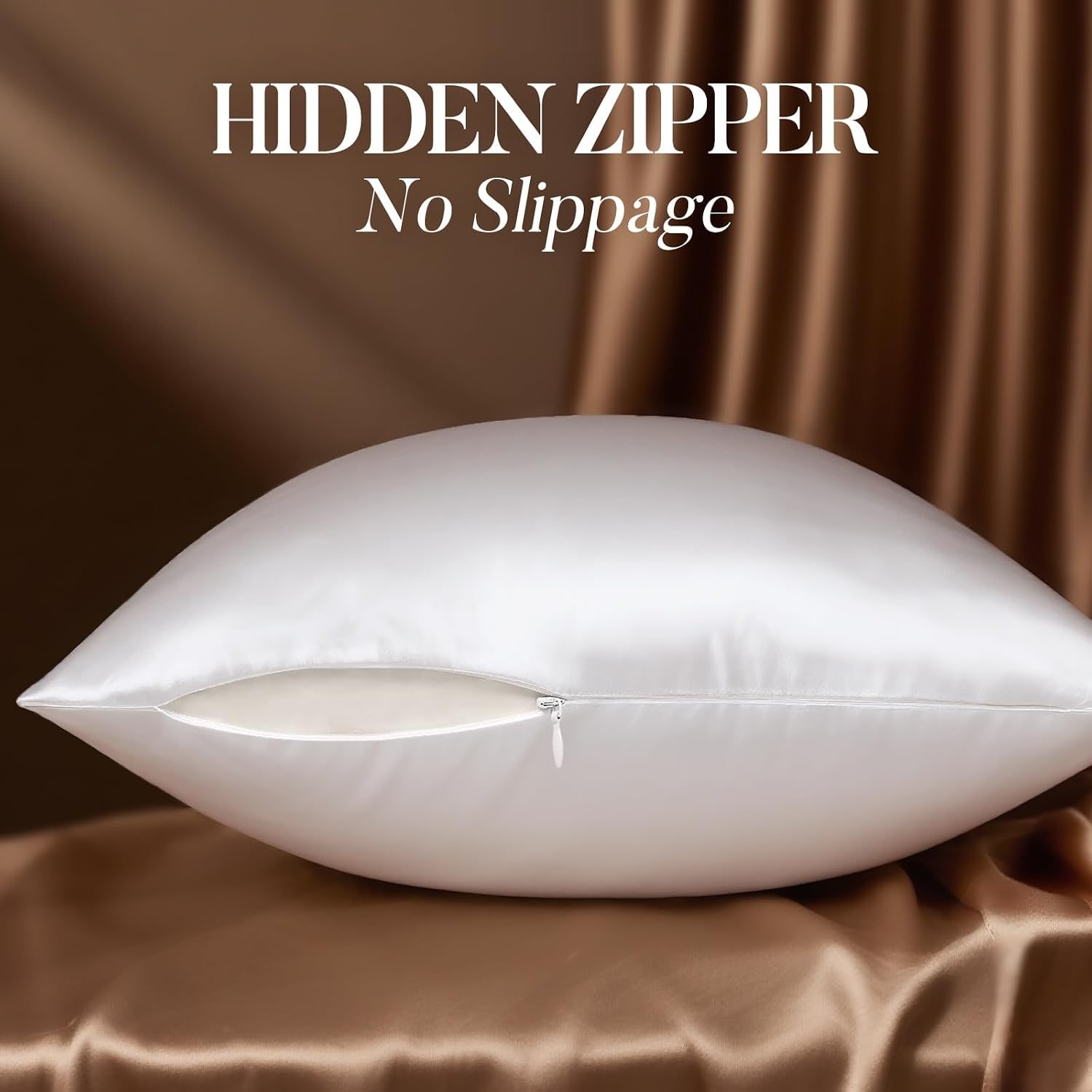
On cotton, either is fine. Cotton has enough friction that a pillow stays put behind a flap. Silk has almost none, which is the whole appeal, and that same slipperiness means a pillow can creep out of an envelope opening over a few nights.
These cases use a hidden zipper. You slide the pillow in, zip it, and the hardware vanishes into the seam. The pillow stays where you put it, and the finished edge looks clean when the bed is made. The zip sits along the bottom, well away from where your head rests on a case this long.
One habit worth building: zip the case shut before it goes in the washing machine. An open zip can snag on itself or on anything else in the drum.
Who gets the most out of silk
People with long hair notice the difference fastest. Long hair has more surface area dragging across the pillow, and more opportunity to tangle. A smoother surface means less of that mechanical catching overnight.
Hot sleepers often like silk too. It feels cool to the touch when you first lie down, and it does not have the insulating fuzz of a flannel or jersey case. Whether that is enough depends on your room, your duvet, and you.
Then there are people who simply like how a bed feels. Silk is one of the few upgrades you notice immediately rather than gradually. There is nothing wrong with buying it for that reason alone.
If you are not sure, the honest advice is to try one night before deciding whether to switch every pillow in the house.
White, and why it works
White is the safest colour in bedding and the most demanding. Safe because it goes with everything, including whatever duvet cover you already own and whatever you buy next. Demanding because marks show.
White silk has a particular quality that white cotton does not. Silk fibre is triangular in cross section, so it reflects light along its length and the white reads as soft and slightly luminous rather than flat. That is why silk photographs the way it does in hotel rooms.
Keeping it white comes down to three habits. Wash regularly rather than waiting for a mark. Use a mild detergent, never bleach. Dry out of direct sunlight, because strong sun is what yellows protein fibres over time.
Care that actually works
Silk has a reputation for being fussy. Most of that reputation comes from silk garments with linings and structure, not from a flat pillowcase.
Wash on a delicate or hand wash cycle in cool water with a detergent made for silk or fine fabrics. Regular laundry detergent often contains enzymes that are designed to break down protein stains, and silk is a protein. A mesh laundry bag is a sensible extra layer of protection.
Skip fabric softener. It coats the fibre with a film that dulls the sheen and takes away some of the slip you paid for.
Hang to dry somewhere with air moving, away from direct sun and away from heat sources. Silk dries fast. If you want it crisp, press on the lowest iron setting, on the reverse side, while it is still a little damp.
Having two cases in the set helps here. One on the bed, one in the wash, no gap.
A few things to check before you buy
Is the silk on both sides, or is one face cheaper fabric? On this set, both faces are mulberry silk.
Is the closure a zip or an envelope? A zip holds better on a slippery fabric.
Does the size match your pillow, not your bed? King cases are 20 x 36 inches.
Is the silk content stated plainly as 100% mulberry silk, rather than as a blend or as "silky"? The difference between silk and a satin weave polyester is large, and the word "satin" describes a weave, not a fibre.
The short version
Two white king pillowcases, 20 x 36 inches (51 x 91 cm), made from 100% grade 6A mulberry silk on both faces, closed with a hidden zipper. The momme weight is not stated by the maker. Care is a cool delicate wash with a gentle detergent, then hang to dry.
Measure your pillow before you order, keep bleach and softener away from them, and the pair will stay smooth through a lot of nights.