
The complete guide
How To Choose And Wear A Long Mulberry Silk Scarf
The problem with most scarves
Most scarves are built for one job. A chunky knit keeps you warm but is useless indoors. A narrow printed square looks smart at the neck and does nothing when a breeze comes through the door. A pashmina covers your shoulders and then sits in a heap because there is no good way to wear it around the neck without bulk.
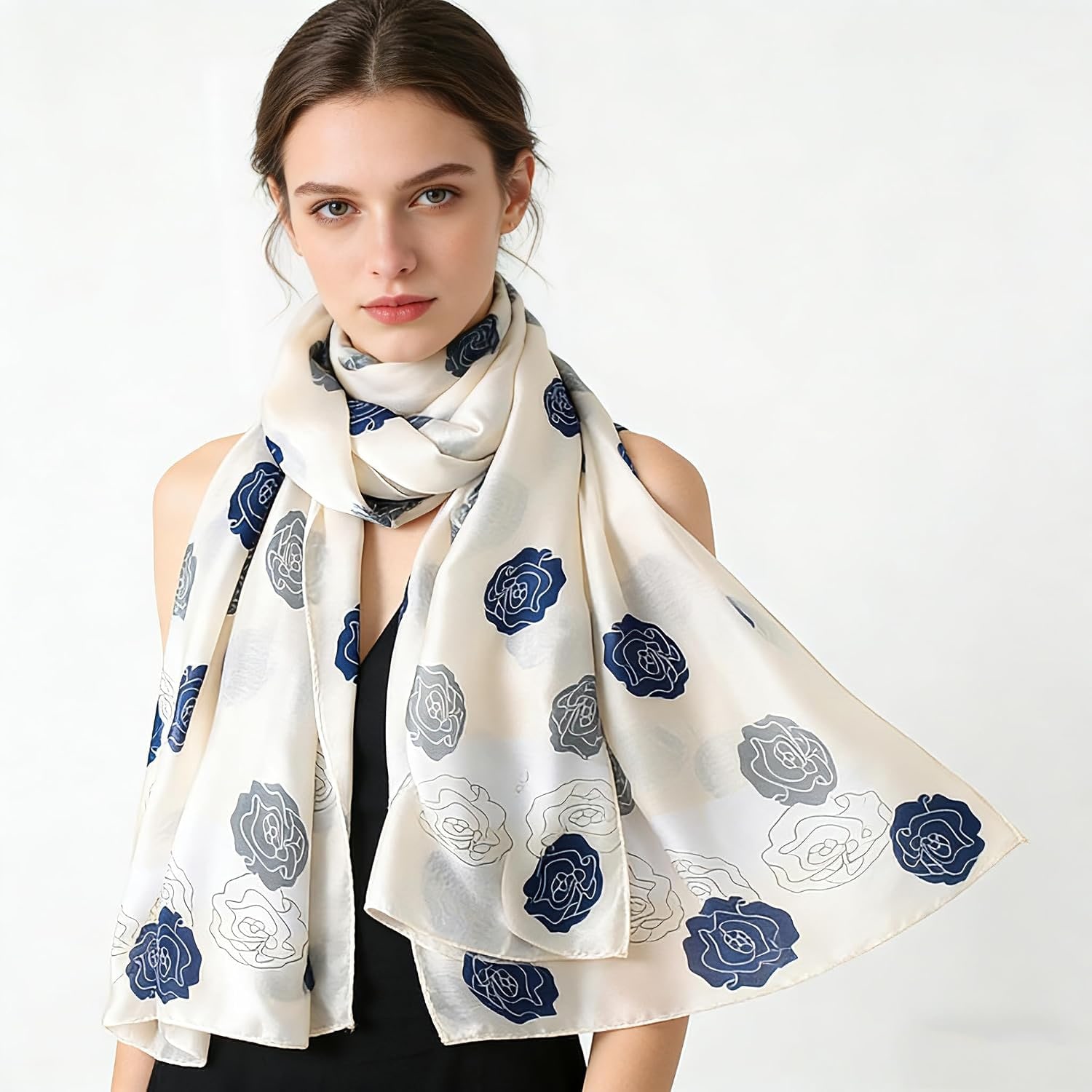
That is why the long silk scarf keeps coming back. At 70 x 35 inches (180 x 90 cm) you are holding something closer to a small shawl that happens to fold down to the size of a paperback. It changes shape to suit the moment. Loop it twice at the neck for the walk to work, open it across the shoulders when the restaurant air conditioning gets ambitious, fold it into a band for the hair when the wind picks up on the ferry.
What mulberry silk actually gives you
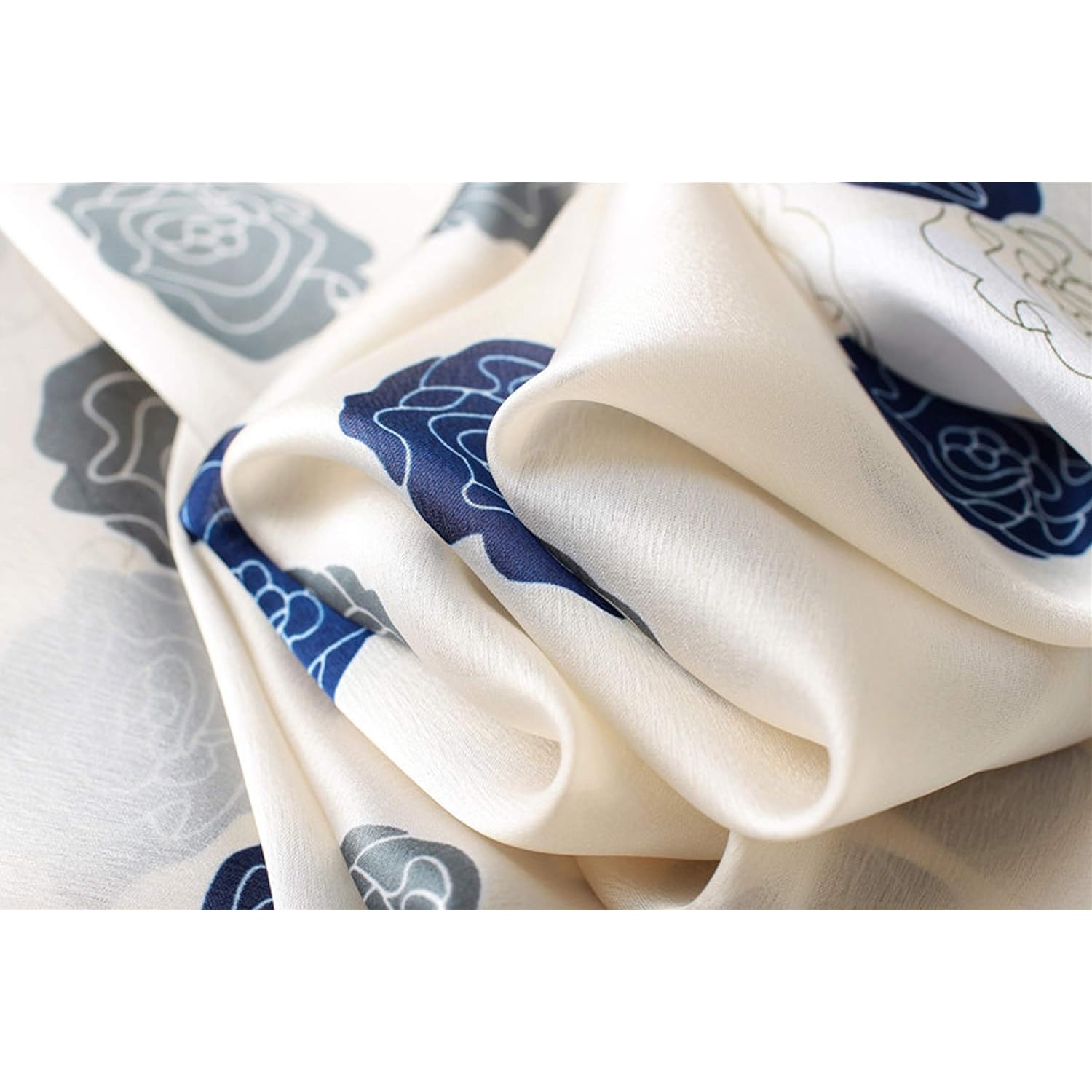
Mulberry silk comes from silkworms fed on mulberry leaves. Their fibre is long, even and smooth, which matters once the yarn is spun and woven. You get fewer short ends poking out of the surface, so the cloth feels consistent all over rather than slightly fuzzy in patches.
This scarf is woven in a satin structure. In a satin weave, the warp yarns float over several weft yarns before dipping under, so more smooth fibre sits on the face of the cloth. The practical results are easy to feel. Light bounces off the surface in a soft sheen instead of a hard shine. The fabric slides over itself, so knots settle rather than lock. And it glides across a coat collar or a knit sleeve instead of snagging on the texture.
There is also the weight question. Silk is light for its surface area. A piece this big in wool would be a serious object to carry. In silk it folds into a handbag and you forget it is there until you need it. That is the whole argument for a lightweight silk scarf over a heavier wrap for daily use.
The navy rose print, and why it is easy to wear
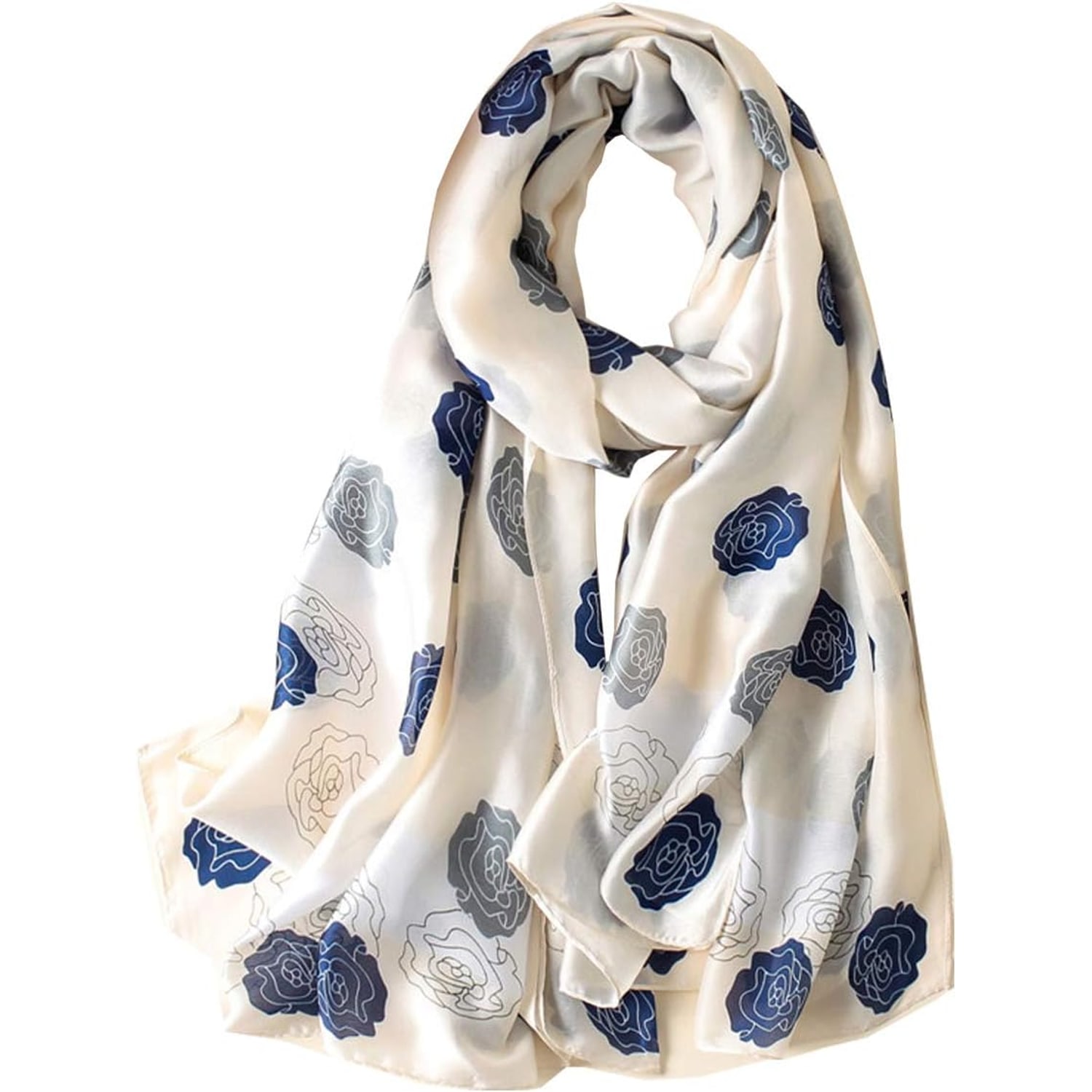
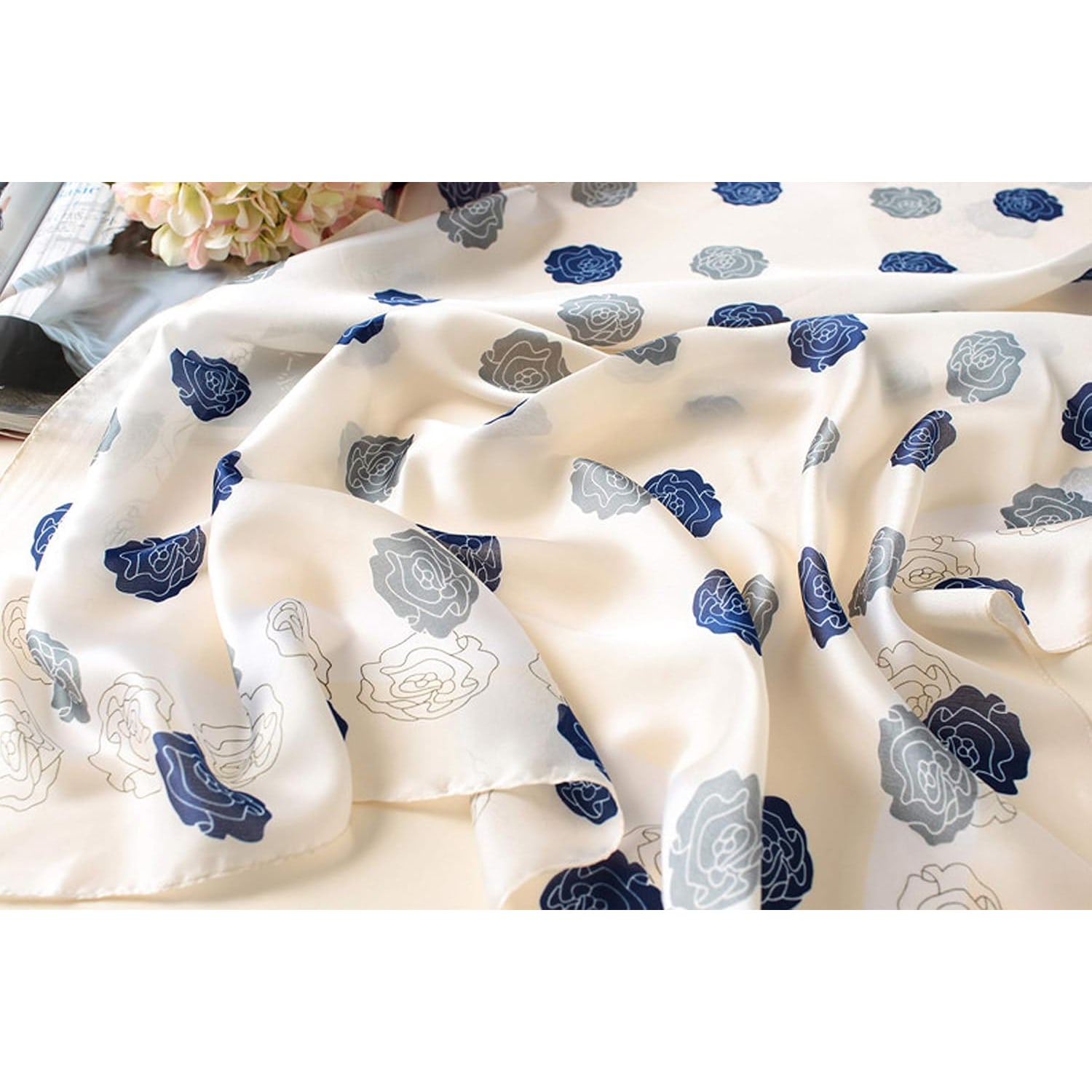
The print is navy and grey roses on a cream ground. Three things make that combination work hard in a wardrobe.
First, the ground is cream rather than white. Cream is warmer and sits more kindly next to skin tones and next to off-white or ivory clothing, which pure white tends to fight with.
Second, the navy does the anchoring. Navy is one of the few colours that reads as a neutral in practice. It sits next to black without clashing, it sharpens denim, and it looks deliberate against camel or tan.
Third, the grey roses soften the contrast. Without them the print would be a hard two-tone pattern. The grey gives a middle step, so from across a room the scarf reads as a tonal floral rather than a graphic one. If you want pattern without becoming the most colourful thing in the room, that middle step is doing the work.
Who this suits
If you are the person who is always slightly cold indoors and slightly too warm outdoors, this is your accessory. One piece covers both states.
It suits travellers for obvious reasons. Planes, trains and long coach rides all involve unpredictable temperature, and a large silk shawl wrap packs into nothing and deploys as a shoulder cover or a makeshift pillow.
It suits anyone who wears a lot of plain clothing. If your wardrobe runs to navy, grey, black, denim and cream, a floral silk scarf is the shortcut to looking put together without buying patterned clothes.
It suits gift buyers because there is no sizing to guess. You do not need to know anyone's dress size, shoe size or neck measurement to buy a scarf.
It is less suited to anyone who needs real cold-weather warmth from the accessory itself. Silk is a light layer. It blocks draughts well tucked into a collar, but for a Canadian January you want it working alongside wool rather than instead of it.
How to choose between scarf sizes
Scarf dimensions tell you more than the price does. Here is the rough map.
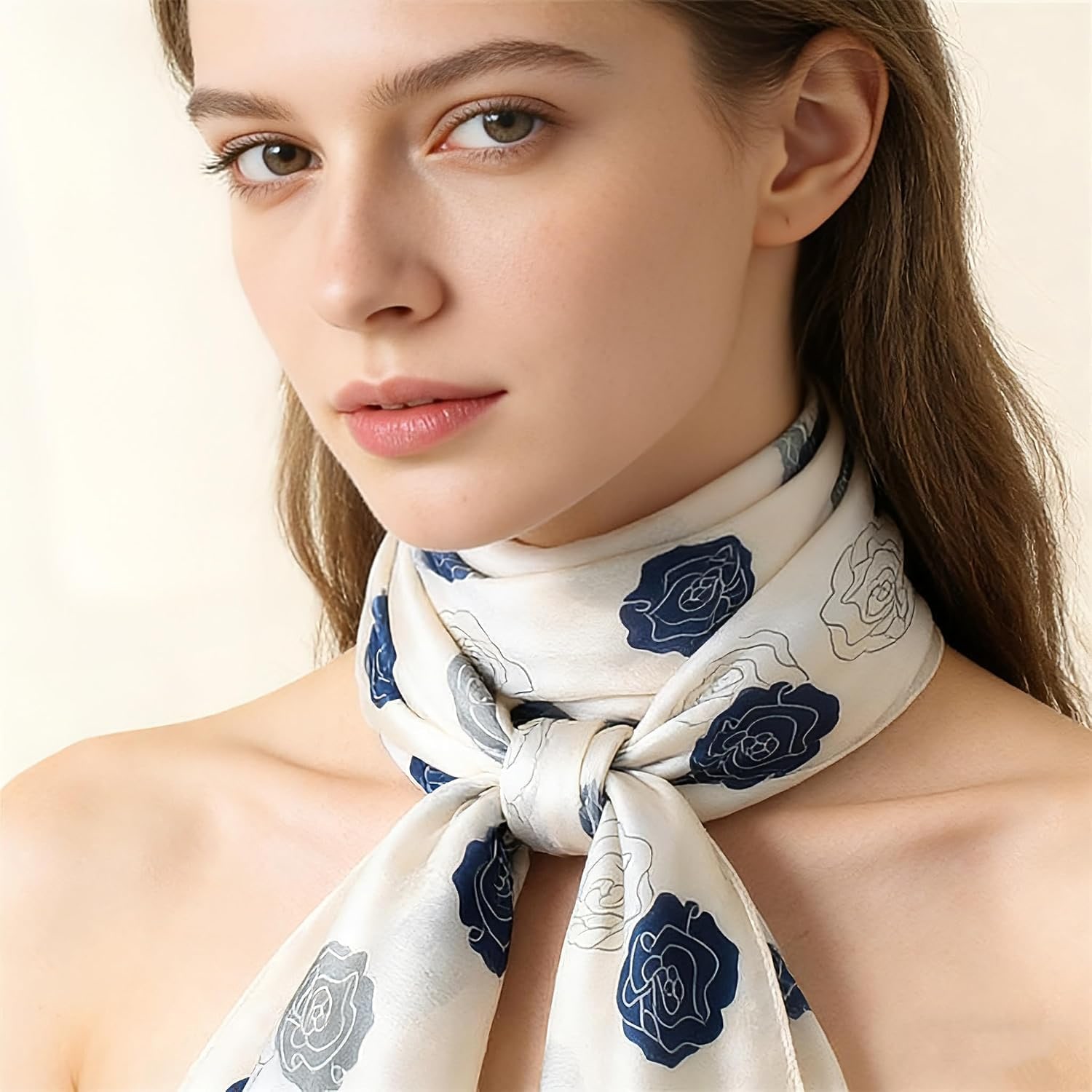
A square around 35 x 35 inches is a neck scarf and a head scarf. It folds into a triangle or a band and sits close. It will not cover shoulders.
A long narrow scarf, say 70 x 12 inches, hangs well and loops nicely but has no width, so it stays a neck piece.
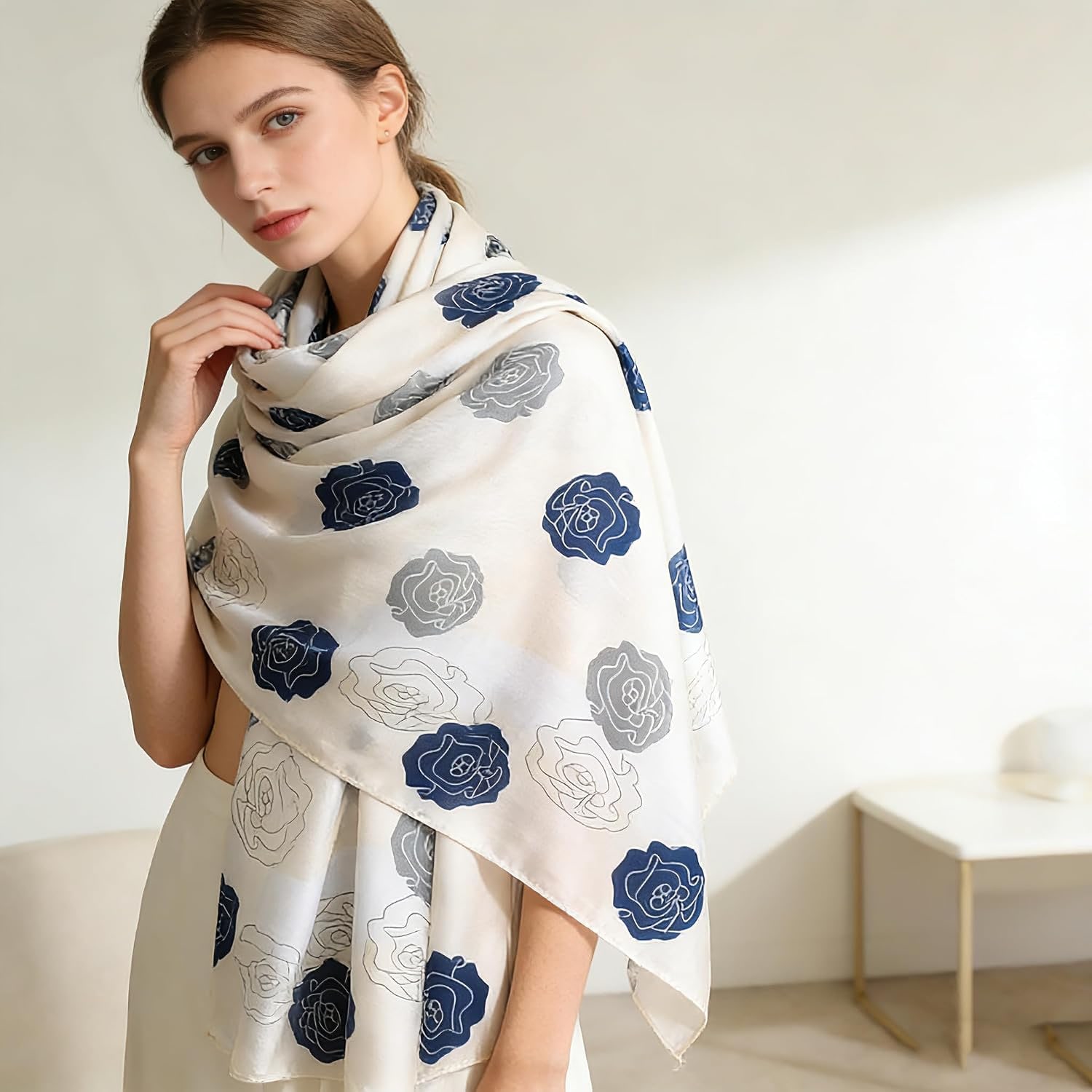
A long wide scarf like this one, at 70 x 35 inches, is the crossover size. Fold it lengthwise and the width disappears into a neat neck drape. Open it and you have shoulder coverage. That flexibility is the reason to pay for the extra fabric.
Beyond that, you are into shawl and stole territory, where the piece is too wide to wear comfortably at the neck without serious bulk.
So the question to ask yourself is simple. Do you want one accessory that does two jobs, or two accessories that each do one job well? If the answer is one, the long wide cut is the one to get.
How to wear it, practically
Start with the double loop. Hold the scarf folded in half lengthwise, drape it around the neck with one long tail and one loop, pass the tails through the loop and tug it to sit where you like. It takes three seconds and looks intentional.
For a flatter look, fold it lengthwise into a band about four inches wide, lay it around the back of the neck and let both ends hang down the front inside a jacket. This is the version that works under a coat, because there is no knot to add bulk at the collar.
For the shawl, open the scarf fully, centre it across your back and bring the ends forward over the shoulders. If you want it secure, cross the ends at the front and tuck them under a belt or into a waistband.
For a head covering, fold into a triangle, place the long edge at the forehead and tie the two ends at the nape. Or fold into a narrow band and tie it over the top of the head with the knot at the side.
For the bag, fold into a band and tie a simple square knot through the handle, leaving two short tails. Silk is light enough that it will not drag on the hardware.
Looking after it
Silk rewards a little care and punishes none at all. The stated care here is hand wash only, so do that.
Use cool water and a mild detergent made for delicates. Swirl the scarf through the water for a minute or two rather than scrubbing it. Rinse in cool water until the water runs clear.
Never wring or twist silk. Lay it flat on a towel, roll the towel up with the scarf inside and press to squeeze the water out. Then unroll and either dry it flat or hang it over a rail.
Keep it out of direct sunlight to dry. Sun fades printed colours faster than anything else, and heat from a radiator can make the fibre feel dry and papery over time.
If you want to press it, use the lowest silk setting with a cloth between the iron and the fabric, ideally while the scarf is still slightly damp.
Two habits extend the life of any silk piece. Put perfume and hairspray on first and let them dry before the scarf goes near your neck. And store it folded or loosely rolled in a drawer rather than hanging on a thin hook, which puts all the weight on one small spot.
The short version
This is a 70 x 35 inch (180 x 90 cm) scarf in 100% mulberry silk, woven in a satin structure, printed with navy and grey roses on a cream ground. The size is the point. It is long enough to loop at the neck and wide enough to cover the shoulders, so one piece handles both the chilly office and the cool evening.
The colours are deliberately easy. Navy anchors, grey softens, cream keeps it light. It will not fight with the clothes you already own.
Care is hand wash in cool water, no wringing, dry flat or in the shade. Do that and it will look the same in five years as it does on day one.
If you have been meaning to replace a scarf that only works half the time, this is the kind of piece that quietly solves the problem.