

The complete guide
The Honest Buyer's Guide to Standard Silk Pillowcases
The small annoyance that silk actually fixes
Most people do not buy a silk pillowcase because of a dramatic problem. They buy one because of a small, repeated annoyance. You turn over in the night and your hair bunches up under your cheek. You wake with creases pressed into one side of your face that take an hour to fade. Your pillow has crept halfway out of its case by morning and the corner is flapping about.
None of these are emergencies. They are just the kind of low-level friction that a change of fabric genuinely does change. Cotton is a spun staple fibre, which means thousands of short fibres twisted together, and the surface of the weave has texture you can feel with a fingertip. Silk is a single long filament reeled off the cocoon, so the surface is smooth in a way cotton cannot be. Skin and hair slide across it instead of catching.
That is the whole story, and it is worth being clear about what it is not. A smooth pillowcase is a smooth pillowcase. It is not a treatment, a remedy or a cosmetic product. What it does is reduce friction, and whether that matters to you depends on how much your hair tangles and how deeply your face creases.
What mulberry silk means, and what grade 6A tells you
Mulberry silk comes from silkworms fed exclusively on mulberry leaves. The controlled diet produces a long, even, pale filament, which is why mulberry silk is the type used for good bedding rather than wild or tussah silk, which is shorter and coarser.
Grade 6A is a classification applied to the raw filament. It looks at length, evenness, colour consistency and lustre. In plain terms, it is a statement about the quality of the thread going into the loom. It is not a measure of how heavy or thick the finished fabric is.
That second measure is momme, written as mm, and it describes fabric weight. For this pair, the maker does not state the momme weight. That is a gap worth knowing about rather than guessing at. If momme is the number you care about most, look for a listing that publishes it. If what you want is mulberry silk on both faces at a standard size, that is what is on offer here, and it is confirmed.
Both sides being silk matters more than people expect. A surprising number of budget pillowcases use silk for the face you see and a cheaper backing for the side nobody looks at. The moment you flip the pillow at 2am you are on cotton or polyester again. Silk both sides removes that problem entirely.
Getting the size right
This is the single most common ordering mistake, and it is easy to avoid.
Standard pillows measure 20 x 26 inches (51 x 66 cm). Queen is 20 x 30 inches. King is 20 x 36 inches. These cases are cut for standard.
Pull a pillow out of its current case, lay it flat on the bed and run a tape measure along the long edge. If you get about 26 inches, standard is right. If you get 30 or 36, you need a different size, because squeezing a queen pillow into a standard case leaves it bulging at the ends and puts strain on the seams every time you stuff it in.
If your pillows are old and have flattened, measure anyway. Flattened pillows often measure slightly longer than when they were new, as the fill spreads sideways.
Why the hidden zipper earns its place
Pillowcase closures come in three broad styles. An open end is the cheapest, an envelope flap folds the fabric back over itself, and a zipper seals the whole thing shut.
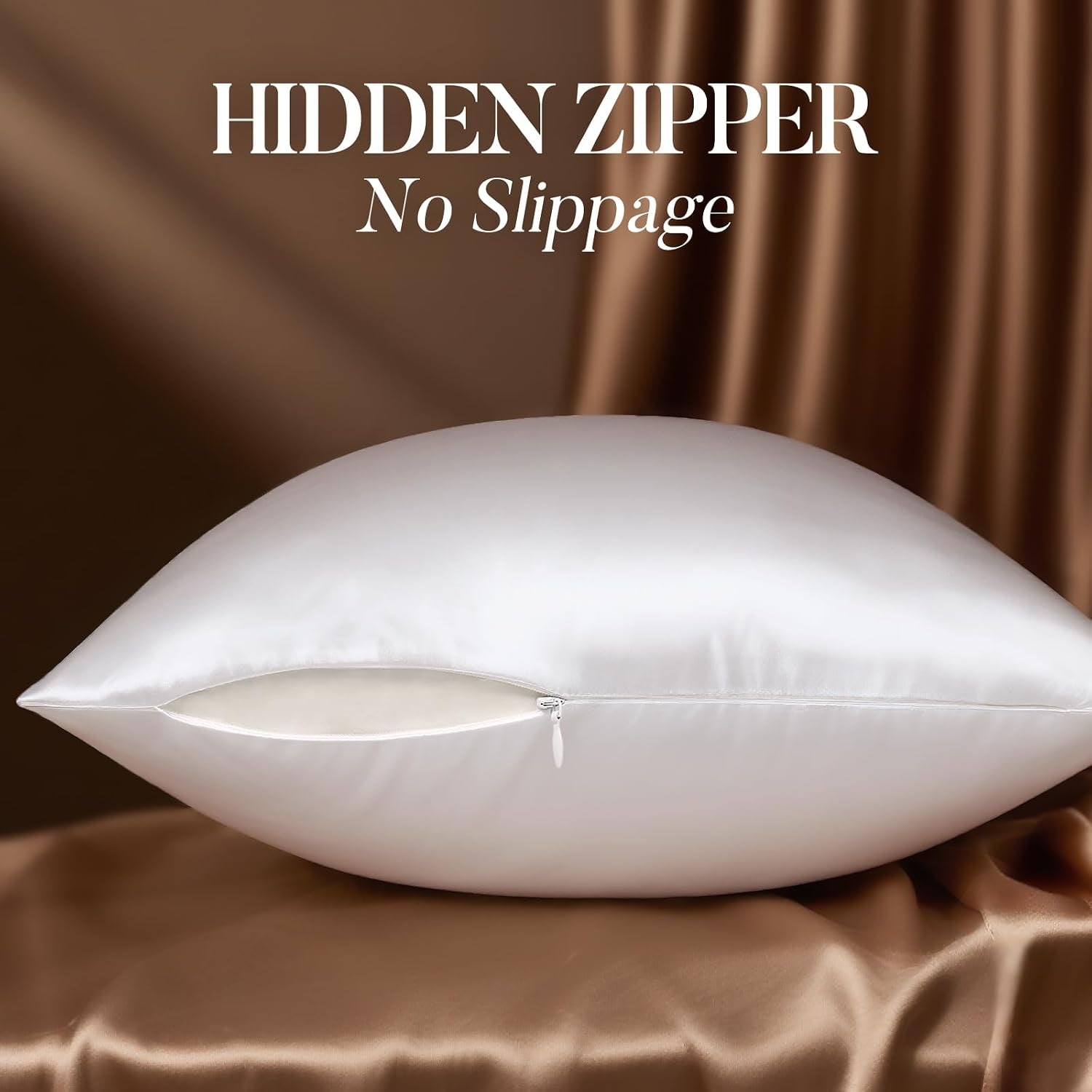
Open ends and envelope flaps both share the same weakness. Over a night of movement, the pillow works its way towards the opening, and by morning there is a gap. On silk this is more noticeable than on cotton, because the fabric is slippery and gives the pillow less grip to hold on to.
A zipper solves it. The pillow stays where you put it, start to finish. Hiding the zipper in the seam means you get the function without a visible strip of plastic teeth across the edge of a made bed, which is the look most people are after when they buy white bedding.
Two small habits keep a zipper happy. Close it fully before washing, so the teeth cannot snag the fabric in the drum. And open and close it slowly, guiding the fabric clear of the slider rather than yanking.
Who suits a pair like this
A two-pack makes most sense for a shared bed. One silk pillowcase on a double is a recipe for quiet resentment. Two means both sides of the bed match and both people get the same surface.
It also suits anyone who wants to wash weekly without stripping the bed bare. One on, one in the laundry, and you are never caught out.
Beyond that, white is the practical choice for guest rooms, rental suites and anyone who changes their bedding colours with the seasons. It is the shade that matches everything, including whatever you buy next year. If you have ever bought a coloured pillowcase and then found it clashed with a new duvet cover, you already know why plain white keeps selling.
The best standard size silk pillowcase for your home is usually the one that disappears into the rest of the bedding rather than announcing itself, and white does that job.
How to look after silk without it becoming a chore
Silk has a reputation for being delicate. It is less fragile than people think, but it does dislike two specific things: heat and harsh chemistry.
Wash on a delicate cycle in cool water. Zip the case closed and pop it in a mesh laundry bag so it does not get caught on a zip or button from something else in the load. Use a small amount of mild liquid detergent. Avoid bleach, avoid oxygen brighteners, and avoid fabric softener, which leaves a residue that takes the shine off the surface.
Hand washing is gentler still if you prefer it. Cool water, a little mild detergent, gentle swishing, then press the water out between your palms. Do not wring it, as twisting stresses the fibres.
Drying is where most damage happens. Hang the cases somewhere with air movement but out of direct sunlight, because strong sun is the main cause of white silk going yellow at the edges. If you must use a dryer, use the lowest heat or an air setting, and take them out slightly damp.
If you want them crisp, iron on a low setting, on the reverse side, while there is still a little moisture in the fabric. A hot iron on dry silk will scorch it.
Done this way, washing a silk pillowcase takes no more thought than washing a wool jumper, and it will stay good for years.
A few things to check before you buy
Measure your pillow. It takes thirty seconds and prevents the only common problem with ordering bedding online.
Decide whether published momme weight matters to you. It is not stated here, and for many buyers that is fine, but it is better to know in advance than to be surprised.
Think about how many you need. Two is right for a shared bed or a weekly wash rotation. If you want pillowcases for a main bed and a spare room, you may want two packs.
Check your laundry setup. If your machine has no cold or delicate cycle, you will be hand washing, which is perfectly workable but worth knowing before the parcel arrives.
The short version
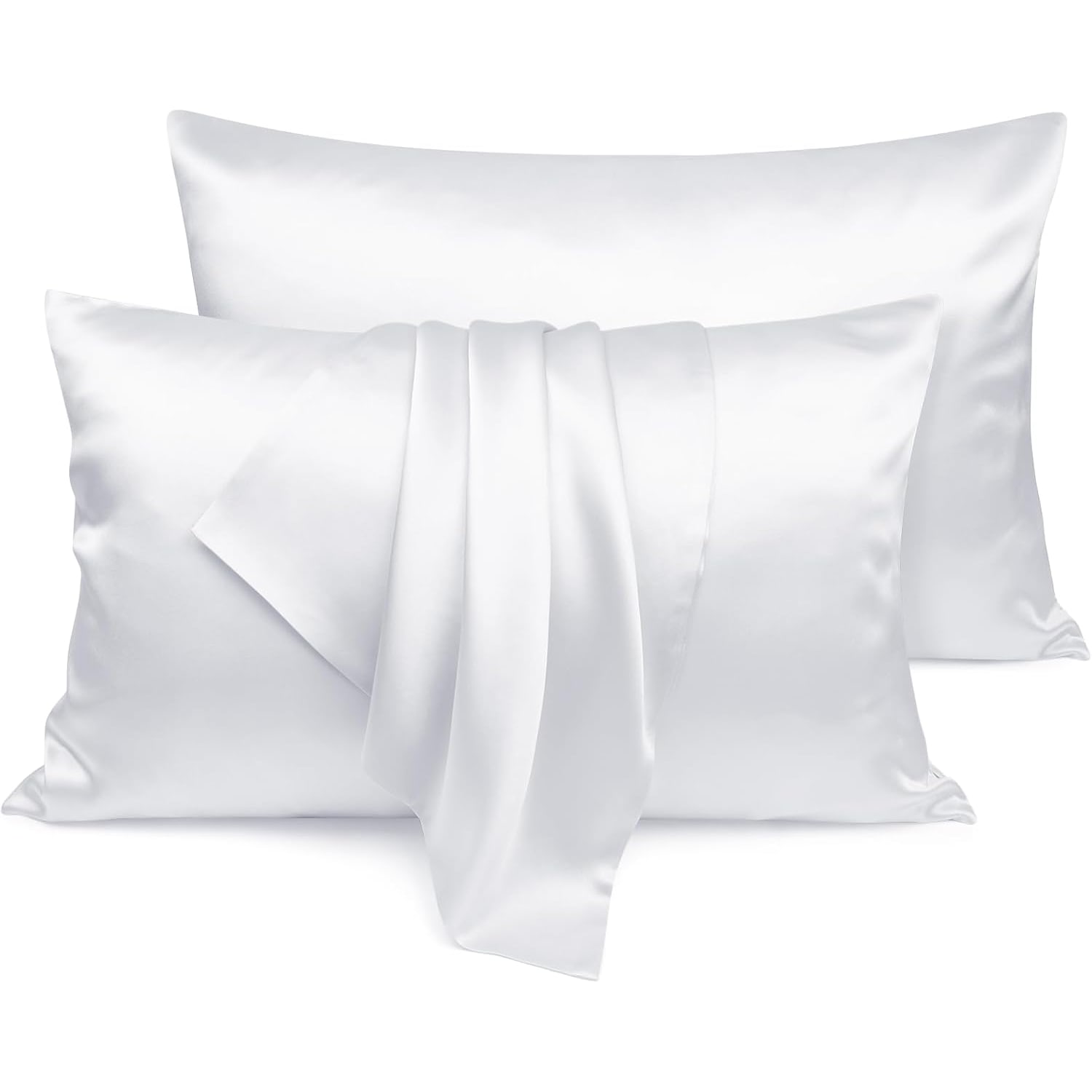
This is a pair of standard 20 x 26 inch (51 x 66 cm) pillowcases, made from grade 6A mulberry silk on both faces, in plain white, closing with a hidden zipper. The momme weight is not published. Care is a cool delicate wash or a hand wash, no bleach, no softener, no hot drying.
What you get for that is a surface with far less friction than cotton, a pillow that stays inside its case all night, and a colour that works with any bedroom you put it in. If your pillows measure standard and you want a matched pair rather than one, this is a sensible place to start with silk.